.svg)
.png)
Conversational automation: identifying the right technology for your challenges
For a CIO or executive considering automating customer support, HR relations, or business processes, confusion between AI agents and chatbots is common. The two terms are often used interchangeably in sales presentations, but they refer to fundamentally different technologies in terms of capabilities, autonomy, and business impact.
However, this distinction is crucial for your ROI: a traditional chatbot follows predefined scripts and is limited to simple responses, with a resolution rate of 20 to 40% according to industry studies. An AI agent, equipped with natural language processing and system integrations, understands context, accesses information systems, makes decisions, and executes complex end-to-end actions, achieving resolution rates of 60 to 80% in successful deployments.
This article clarifies the concrete differences between traditional virtual assistants and conversational artificial intelligence, and helps decision-makers choose the right solution for their automation challenges.
Classic chatbot: automation of scripted conversations
A traditional chatbot (or conversational bot) operates based on preprogrammed decision trees. If the user says "reset my password," the chatbot asks a series of fixed questions following a defined workflow: "Which system?" "Which username?" and then redirects to a form or knowledge base article.
The problem: if the request deviates from the script, the chatbot does not understand the wording and systematically escalates to a human. Chatbots are effective for simple FAQs and predictable recurring requests, but they quickly show their limitations when faced with the variety of real-world wording and the complexity of business requests.
Technical characteristics of a classic chatbot
- Fixed decision tree: if/then logic without the ability to adapt
- Limited understanding of natural language: keyword recognition only
- No access to systems: no connection to databases, ERP, CRM, or HRIS
- Informative capabilities only: cannot perform actions, only provide guidance
- Heavy maintenance: each new use case requires manual addition to the decision tree
- Resolution rate: 20-40% of requests according to industry benchmarks (source: our analysis of customer deployments 2023-2025)
AI agent: intelligent and autonomous automation
An AI agent (or intelligent conversational agent) truly understands the request thanks to advanced natural language processing (NLP), based on models such as GPT-4, Claude, or specialized LLMs. It analyzes the entire context: who the user is, their interaction history, the level of urgency, and the permissions they have.
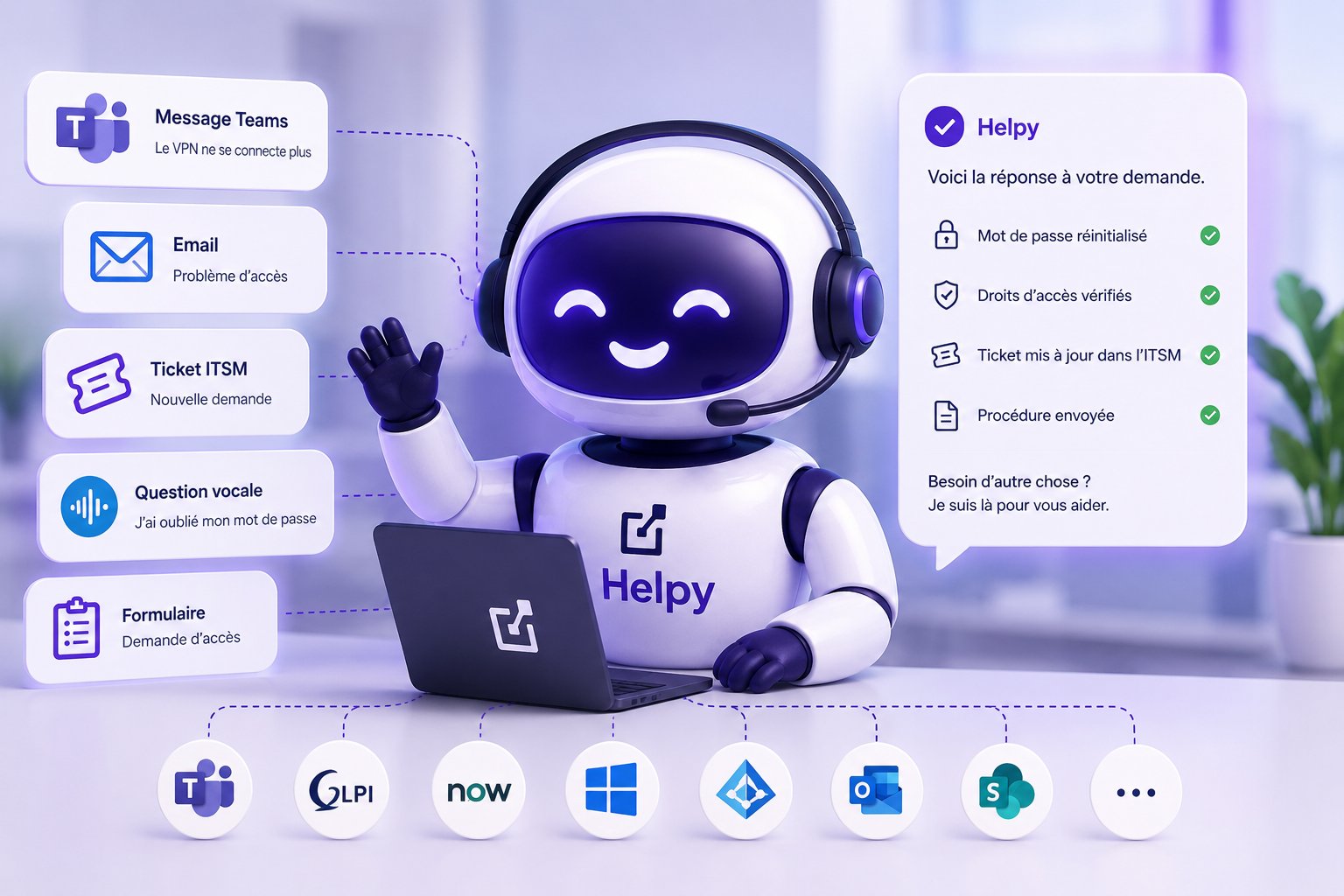
The AI agent does not just respond: it accesses information systems via API to verify data in real time, validates permissions, and can execute the action directly in the relevant system.
Concrete example: password reset
With a traditional chatbot:
- The user submits their request
- The chatbot asks 3-4 qualifying questions.
- Redirect to a web form
- Creating a ticket in the support tool
- Level 1 human intervention (response time: 2-4 hours)
With an AI agent:
- The user formulates their request in natural language.
- The agent automatically verifies identity in Active Directory.
- Validation of rights and permissions
- Generation of a secure temporary password
- Automatic encrypted email with activation link
- Action logging for compliance and auditing
- Total time: 30 seconds, without human intervention
Technical characteristics of an AI agent
- Advanced contextual understanding: NLP with language models (GPT-4, Claude, LLaMA)
- Multi-platform access: native connection to databases, ERP, CRM, HRIS, Active Directory via REST/GraphQL API
- Execution capability: account creation, data modification, triggering of automated workflows
- Intelligent exception management: analysis of complex cases and autonomous arbitration
- Continuous learning: gradual improvement through machine learning and feedback loops
- Resolution rate: 60-80% with full SI integration (source: IT Systems customer deployments 2024-2025)
Detailed comparison table: chatbot vs. AI agent
When to choose a chatbot vs. an AI agent?
Use cases suitable for traditional chatbots
A chatbot remains relevant in specific contexts:
- Highly repetitive FAQs with fewer than 50 standard questions and predictable wording
- Limited budget (less than €15,000) with no need for system integration
- No IS integration required: pure information without access to business data
- Simple level 0 decongestion need: referral to the right resources (self-service, documentation)
- Environment without available APIs: legacy systems without integration capabilities
Concrete example: FAQ chatbot on an e-commerce site to answer questions such as "What are your delivery times?" or "How do I return an item?"
Use cases requiring an AI agent
An AI agent becomes indispensable as soon as you need to:
Level 1-2 IT support
- Active Directory access for account and permission management
- ServiceNow or Jira integration for ticket creation/updating
- Consultation of technical knowledge bases with contextual understanding
- Performing actions: unlocking accounts, resetting passwords, provisioning access
Automated HR onboarding
- Automatic creation of user accounts (email, Active Directory, business tools)
- Provisioning of access based on profile and department
- Generation and sending of personalized documents (contracts, job descriptions)
- Monitoring of the integration process with automatic reminders
Accounting and financial processing
- Intelligent data extraction from PDF invoices (OCR + NLP)
- Automatic validation according to business rules and thresholds
- ERP integration for accounting records
- Exception management and anomaly alerts
Advanced customer support
- Real-time CRM access (Salesforce, HubSpot, Microsoft Dynamics)
- Triggering actions: refunds, reshipments, commercial gestures
- Customer sentiment analysis and intelligent escalation
- Customization of responses based on customer history
Key decision criterion
If your process requires contextual understanding AND actions in the information system, an AI agent is essential.
→ Customer cases:Level 1 Helpdesk Agent |Employee OnboardingAgent
Business impact: key figures and comparative ROI
Quantifiable gains with an AI agent vs. chatbot
Reduction in the volume of Level 1 tickets:
- Chatbot: 15-25% discount
- AI agent: 50-70% reduction
Average resolution time:
- Chatbot: 2-4 hours (with human intervention)
- Agent IA : <5 minutes (traitement automatisé)
Customer satisfaction (CSAT):
- Chatbot: 3.2/5 on average
- AI agent: 4.3/5 on average
Cost per interaction processed:
- Level 1 human support: €8–15
- Chatbot: $0.50–$2
- AI agent: €0.80-3 (depending on API usage)
ROI calculation over 3 years (example: company with 500 employees)
Traditional chatbot scenario:
- Initial investment: €15,000
- Recurring costs (3 years): €36,000
- Automated tickets: 30% × 10,000 tickets/year = 3,000 tickets/year
- Annual savings: 3,000 × $12 = $36,000
- ROI over 3 years: 111% (€108K saved for €51K invested)
AI agent scenario:
- Initial investment: €50,000
- Recurring costs (3 years): €72,000
- Automated tickets: 65% × 10,000 tickets/year = 6,500 tickets/year
- Annual savings: 6,500 × $12 = $78,000
- ROI over 3 years: 192% (€234K saved for €122K invested)
These figures are based on our 2023-2025 customer deployments and may vary depending on the context.
Frequently Asked Questions - AI Agent vs. Chatbot
Can an AI agent completely replace a chatbot?
Yes, an AI agent incorporates all the capabilities of a traditional chatbot and goes beyond. An AI agent can handle simple FAQs as well as perform complex actions in your systems. However, if your needs are strictly limited to very simple FAQs with no need for evolution, a chatbot may suffice and will cost less in the short term.
What is the average ROI of an AI agent in a business?
The return on investment typically ranges from 6 to 18 months, depending on the complexity of the integrations and the volume of requests processed. The key factors are: the volume of Level 1 tickets, the hourly cost of your support teams, and the automation rate achieved. A well-integrated AI agent can automate 60–80% of recurring requests.
Should we replace our current chatbot with an AI agent?
Not necessarily. If your chatbot handles more than 70% of customer needs without requiring escalation and you don’t need automated actions in your systems, keep it. However, if you see a high escalation rate (>50%) or if you need to automate entire processes, migrating to an AI agent will quickly pay off.
What are the technical requirements for deploying an AI agent?
The main prerequisites are:
- APIs available on your target systems (ERP, CRM, HRIS)
- Cloud or hybrid infrastructure to host the agent
- Security policy allowing API connections with OAuth/JWT authentication
- Documented knowledge base (FAQs, procedures, guides)
- Project team with IT integration skills (API developer, IT architect)
Are AI agents compatible with our existing tools?
Yes, modern AI agents connect to most enterprise tools via standard REST APIs: Salesforce, ServiceNow, Microsoft 365, SAP, Workday, Active Directory, etc. Integration is done via preconfigured connectors or custom APIs depending on your technical stack. During the audit, we systematically check compatibility with your existing IT system.
How can we measure the performance of an AI agent?
The key KPIs to monitor are:
- First Contact Resolution Rate
- Average resolution time
- User satisfaction rate (CSAT/NPS)
- Volume of tickets escalated to humans
- Cost per interaction processed
- Agent utilization rate vs. traditional channels
What is the difference between an AI agent and a virtual assistant?
The terms largely overlap. A “virtual assistant” generally refers to any conversational interface (chatbot or AI agent). An “AI agent” emphasizes advanced artificial intelligence capabilities (NLP, machine learning, action execution). In practice, a modern virtual assistant is often an AI agent.
Is the data processed by the AI agent secure?
Yes, enterprise AI agents comply with security standards:
- Data encryption in transit (TLS 1.3) and at rest (AES-256)
- Strong authentication (OAuth 2.0, SSO, MFA)
- GDPR compliance with data hosting in Europe
- Complete audit logs for traceability
- Granular permission management by user role
During deployment, a security audit is systematically performed.
Next steps: identifying the solution that best suits your needs
The choice between a chatbot and an AI agent depends on three key factors:
- Complexity of your processes: simple actions (chatbot) or end-to-end with IT integrations (AI agent)
- Volume and recurrence: a few hundred requests per month (chatbot) or several thousand (AI agent)
- ROI objective: basic decongestion (chatbot) or transformation of the user experience (AI agent)
Our recommendation: if you are unsure, start by auditing your processes. We analyze your ticket volume and existing systems, and calculate the projected ROI for each option.
Internal links and additional resources
→ Discover: What ROI can you expect from an AI agent project in your company? - What productivity gains can you expect from AI agents?
→ Learn more: AI agents for businesses
→ Methodology: How to integrate an AI agent into your existing information system?
→ Security: How can you secure an AI agent project in your company?




.svg)