.svg)
.png)
How to integrate an AI agent into an existing information system? Technical guide for CIOs
For a CIO, integrating an AI agent into a complex information system represents a major technical challenge before launching an artificial intelligence project in a company. How can the AI agent be connected to critical business applications (ERP, CRM, HRIS) without overhauling the existing IT architecture? How can data security and regulatory compliance be guaranteed? How can SSO authentication and user access rights be managed?
This article details IT Systèmes' proven AI agent integration methodology, key technical choices, and best practices for seamless deployment in your information system.
IT architecture audit: the first critical step before integrating an AI agent
Before any development, we conduct a detailed information system architecture audit to accurately map your existing IS:
- Which systems should be connected to the AI agent (ERP, CRM, HRIS, databases, legacy business applications)?
- Which REST APIs or SOAP APIs are available and documented?
- Which authentication protocols are deployed (OAuth 2.0, SAML, OpenID Connect, certificates)?
- What is your IT security policy (Azure/AWS private cloud, on-premises infrastructure, hybrid architecture)?
This audit identifies strategic integration points, anticipates technical and regulatory constraints, and designs a target AI agent architecture that fits seamlessly into your existing information system without disrupting operations.
Duration of the IS audit: 1 to 2 weeks depending on the complexity of the information system.
The three ways to integrate AI agents into an existing IS
1. AI agent integration via REST API (recommended method)
The AI agent connects to your systems via their native REST APIs. This is the cleanest, most maintainable, and most scalable method of integrating an AI agent.
We develop secure API connectors that call your business application endpoints (GET, POST, PUT, DELETE requests) in strict compliance with the authentication in place (API keys, OAuth 2.0, SSL/TLS certificates). The AI agent can thus:
- Query your Salesforce or Microsoft Dynamics CRM (search for a customer, view history)
- Modify your SAP or Oracle ERP (create an order, update inventory)
- Consult your HRIS (check employee information, manage leave)
Main advantage: non-intrusive integration, no changes to your existing systems, decoupled architecture.
Prerequisite: your applications must expose documented APIs (this is the case for 90% of modern cloud tools: Salesforce, SAP S/4HANA, Microsoft 365, ServiceNow, Workday).
2. AI agent integration via native connectors for standard applications
For standard SaaS applications (Microsoft 365, Salesforce, SAP, SharePoint, Microsoft Teams, Slack, ServiceNow), we use certified, ready-to-use native connectors that significantly speed up AI agent integration.
These preconfigured connectors automatically manage:
- Single Sign-On (SSO) authentication
- User permissions and roles management
- Optimized API calls and quota management
- Error handling and automatic retries
The AI agent can send emails via Outlook, create tickets in ServiceNow, access SharePoint documents, or post in Teams without custom API development.
Measured time savings: 50% reduction in integration time compared to custom API development.
3. AI agent integration via middleware/ESB for legacy IS
For complex legacy information systems (IBM mainframe applications, AS/400, older Oracle databases, proprietary business software packages), we deploy integration middleware or an ESB (Enterprise Service Bus) that acts as a translator between the AI agent and your legacy systems.
The middleware exposes modern REST APIs that the AI agent can easily consume, while managing the complexity of legacy protocols (SOAP, XML-RPC, ODBC/JDBC connectors) in the backend. This integration approach avoids costly redesign of your critical systems while making them accessible to artificial intelligence.
Integrating an AI agent with an existing ERP system
Integrating an AI agent with an ERP system (SAP, Oracle, Sage, Cegid, Microsoft Dynamics) is the most transformative—and often the most complex—project for an IT department. Unlike modern SaaS applications, ERP systems are mission-critical transactional systems where an error by the AI agent can have immediate consequences for business operations.
Our three-step approach:
Level 1 — Read-only (2 to 4 weeks) The agent consults the ERP system to answer business-related questions: order status, inventory levels, supplier history. No operational risk, immediate value for teams. This is the recommended starting point for any ERP integration project.
Level 2 — Guided Actions with Human Validation (4 to 8 weeks) The agent prepares an action in the ERP system (creating a purchase order, updating a customer record) and submits a validation request to an operator before execution. This represents the optimal balance between automation and oversight.
Level 3 — Supervised Independent Actions (8 to 16 weeks) The agent directly performs actions in the ERP system within a strictly defined scope and subject to limit rules. This level is reserved for well-established processes, following successful completion of Levels 1 and 2.
ERP Compatibility: SAP S/4HANA exposes native REST APIs via the Business Technology Platform. Microsoft Dynamics 365 integrates via Microsoft Graph. Sage and Cegid have documented APIs. For ERPs without APIs, we deploy an ESB middleware connector as described in the previous section.
Typical technical architecture for integrating an AI agent into an IS
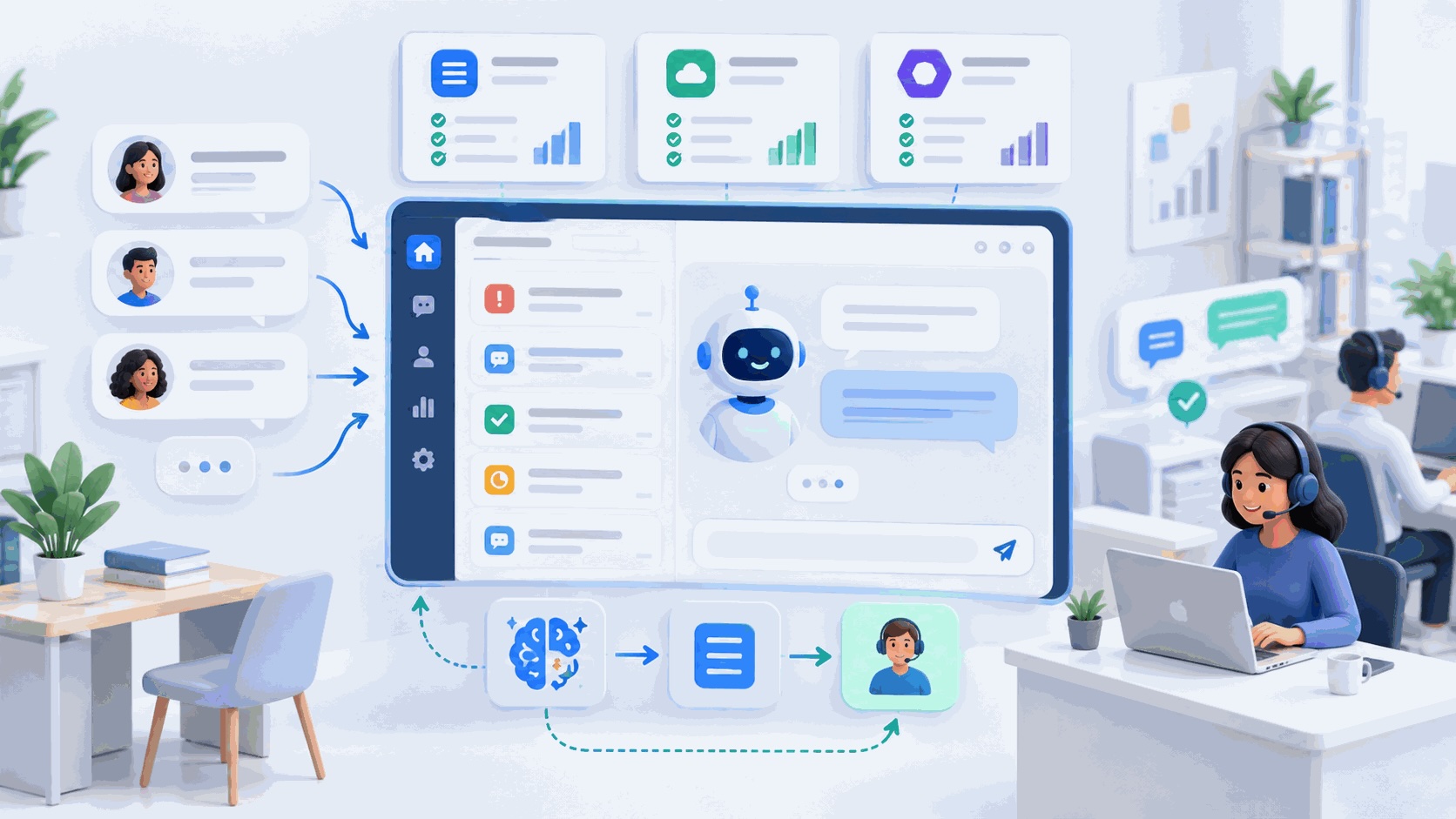
Layer 1: AI agent user interface
- Microsoft Teams / Slack chat
- Responsive web interface
- Native integration into your existing business applications
Layer 2: AI agent engine (NLP + orchestration)
- Natural language understanding (GPT-4, Claude, private LLM models)
- Conversational context management and memory
- Intelligent orchestration of multi-system actions
Layer 3: Secure integration layer (API Gateway)
- Centralized SSO authentication (SAML, OAuth 2.0)
- Fine-grained permission management (RBAC, ABAC)
- End-to-end encryption (TLS 1.3)
- Detailed audit logs and full traceability
Layer 4: Target systems (ERP, CRM, HRIS, databases)
- Connection via secure REST APIs
- Certified native connectors
- Integration middleware for legacy systems
Management of authentication and permissions for the AI agent
Fundamental principle: the AI agent strictly inherits the permissions of the user interacting with it. If an employee asks the AI agent to create an order in the ERP, the agent verifies in real time that this employee has the right to create orders in the system (verification via Active Directory, RBAC, or your IAM solution).
No privilege escalation: the AI agent can only perform actions that the user could perform manually in business applications. This approach ensures the security and regulatory compliance of the integration.
SSO authentication (SAML 2.0, OAuth 2.0, OpenID Connect) eliminates the need to manage additional passwords and simplifies the user experience. Every action performed by the AI agent is tracked in a secure audit log with precise timestamps, user identity, action performed, target system, and operation result.
AI agent deployment: private cloud vs. on-premises infrastructure
Deployment of AI agent in private cloud (Azure, AWS, GCP)
The AI agent is hosted on your private cloud tenant (Microsoft Azure, AWS, or Google Cloud Platform) in your chosen geographic region (e.g., EU-West for strict GDPR compliance).
Benefits of private cloud deployment:
- Automatic scalability based on load (autoscaling)
- Guaranteed high availability (99.9% SLA)
- Controlled infrastructure costs (pay-as-you-go model)
- Simplified and automated AI agent updates
- Secure connection to your cloud applications via IPsec VPN or Azure Private Link
Your sensitive data remains in your private cloud tenant, with no transfer to public or third-party servers. This is the recommended deployment mode for 80% of AI agent integration projects in companies.
On-premise AI agent deployment (on internal infrastructure)
For organizations with strong sovereignty constraints (banking, insurance, defense, healthcare, sensitive industries), the AI agent can be deployed entirely on your on-premise servers.
Features of on-premise deployment:
- The AI agent operates locally on your LAN network.
- Direct access to internal systems without Internet exposure
- No Internet connection required to operate (except when using external cloud APIs)
- Full control of infrastructure and security
Disadvantages: infrastructure to be managed internally, higher fixed costs, technical maintenance to be planned for.
Major advantage: complete control over infrastructure, security, and data location.
Methodology for integrating AI agents into IT systems: deployment in five phases
Phase 1: Information system audit (1-2 weeks)
- Complete mapping of systems to be connected
- Identification and documentation of available APIs
- Analysis of security and regulatory compliance constraints
Phase 2: AI agent target architecture (1 week)
- Designing the optimal integration architecture
- Choice of deployment mode (private cloud/on-premises)
- Validation of the architecture with your IT teams
Phase 3: Connector development (2-4 weeks)
- Development of secure API connectors
- Unit tests and integration tests
- Robust error handling and automatic retries
Phase 4: End-to-end integration testing (2 weeks)
- Complete functional testing in an acceptance environment
- Permission and security validation
- Load and performance testing
- End-user recipe
Phase 5: AI agent production launch (1 week)
- Gradual deployment in production (phased approach)
- Real-time monitoring and alerts
- Complete technical documentation and team training
- Post-deployment support
Frequently asked questions about integrating AI agents into the IS
Is my IT system compatible with an AI agent, or does everything need to be redesigned?
In 95% of cases, no system overhaul is required to integrate an AI agent. If your applications expose REST APIs (which is the case for all modern cloud tools: Salesforce, SAP S/4HANA, Microsoft 365, ServiceNow), integration is straightforward via secure connectors. For legacy systems (mainframes, AS/400, older Oracle databases), we deploy middleware that acts as a translator between the AI agent and your legacy systems, without modifying the latter. The initial architecture audit (1–2 weeks) precisely identifies the integration points and the optimal strategy based on your technical environment.
How long does it take to integrate an AI agent into our systems?
For a simple integration (1–3 systems with standard REST APIs, such as Salesforce and Microsoft 365): allow 4–6 weeks for development, including testing and deployment. For a complex integration (5+ systems, a mix of cloud and on-premises environments, legacy systems, and enhanced security requirements): allow 8–12 weeks. Our 5-phase methodology significantly accelerates timelines: IT audit (1–2 weeks), architecture (1 week), connector development (2–4 weeks), end-to-end testing (2 weeks), and deployment (1 week). The use of certified native connectors for standard applications reduces integration time by 50%.
Can the AI agent securely access our sensitive data?
Yes, with a strict security architecture: the AI agent only inherits the permissions of the user interacting with it (least privilege principle), authenticates via SSO (SAML 2.0, OAuth 2.0) without additional password management, and encrypts all communications using TLS 1.3. Each action is tracked in an immutable audit log with user identity, timestamp, action performed, and target system. Your sensitive data remains on your infrastructure (Azure/AWS private cloud or on-premises) without ever passing through third-party public servers. This approach ensures GDPR, NIS2, and ISO 27001 compliance.
What systems can be connected to an AI agent?
The AI agent can connect to all your critical systems: ERP (SAP, Oracle, Microsoft Dynamics), CRM (Salesforce, HubSpot, Zoho), HRIS (Workday, SAP SuccessFactors, ADP), collaboration tools (Microsoft 365, Google Workspace, Slack, Teams), ticketing platforms (ServiceNow, Jira, Zendesk), databases (SQL Server, Oracle, PostgreSQL, MongoDB), and legacy systems via middleware. For standard SaaS applications, we use certified native connectors that accelerate integration by 50%. For proprietary business software or mainframe systems, we develop custom API connectors that meet your technical and security requirements.
Should the AI agent be deployed in the cloud or on-premises?
Both options are viable depending on your requirements. The private cloud (Azure, AWS, GCP) is recommended for 80% of projects: automatic scalability, high availability (99.9% SLA), controlled costs (pay-as-you-go), simplified updates, and secure connectivity via IPsec VPN or Azure Private Link. Your data remains in your private tenant within the EU region for GDPR compliance. On-premises deployment is suitable for highly regulated sectors (banking, defense, healthcare) requiring absolute sovereignty: the agent runs locally on your LAN with direct access to internal systems without Internet exposure. Drawback: infrastructure must be managed internally and fixed costs are higher.
How to manage the access rights of the AI agent?
The AI agent has no high-privilege service accounts: it strictly inherits user permissions via SSO and verifies rights in your Active Directory or IAM solution in real time before each action. If an employee asks the agent to create an order in the ERP, the agent first verifies that the employee has the right to create orders. No privilege escalation is possible. This architecture ensures that no user can bypass the security policy via the AI agent. Rights are managed centrally in your existing IAM tools (Active Directory, Azure AD, Okta) without duplication or orphaned accounts.
What happens if a target API is unavailable?
Our connectors feature robust error handling with intelligent automatic retries: if an API is
Internal links and additional resources
→ Discover: What ROI can you expect from an AI agent project in your company? - What productivity gains can you expect from AI agents?
→ Learn more: AI agents for businesses
→ Security: How can you secure an AI agent project in a business setting?
→ Which solution to choose: AI agent vs. chatbot: what are the differences for businesses?





.svg)