.svg)

"How much does an AI project cost?" That’s the first question we’re asked in meetings, often before we’ve even understood the need. And the honest answer is that the question is misguided: the term “AI” encompasses at least four very different levels of projects, with budgets ranging from €5 per month per user to €90,000 for the first version of a business application.
In short: An AI agent costs anywhere from €5 per user per month (for managing consumer AI use) to €90,000 for a comprehensive business software solution. In between, a custom-built agent connected to your data starts at around €5,000 for a targeted module. The determining factor isn’t the size of your company—it’s the nature of your needs.
Asking how much “an AI project” costs is like asking how much “a vehicle” costs: the answer makes no sense unless you specify whether you’re looking for a bike, a car, or a truck. In this article, we present our four actual price ranges, along with the specific cases they’re based on. All figures come from our operations at IT Systèmes. These are indicative ranges—the final price always depends on the exact scope of work, which we calculate during the planning phase—but these orders of magnitude give you a good idea of whether you’re looking at a project costing €5,000 or €90,000. And that’s often what helps break the deadlock and make a decision.
2. Our pricing: the 4 levels of IT Systems support
Level 1 — AI Proxy: Host Shadow AI starting at €5/month
Your employees are already using ChatGPT, Claude, Gemini, or Copilot—on their work computers, on their personal phones, and sometimes by pasting snippets of contracts or customer emails without even thinking about it. This is “Shadow AI ”: AI that’s present throughout the company, without any oversight or control.
You have two bad options and one good one. Blocking access: people will just switch to 4G on their phones and carry on. Opening everything up without oversight: you’re taking a major legal risk, with no way to track what’s coming in and going out. The right option is managed access: a single interface to AI services on the market, hosted in France, that anonymizes sensitive data before sending it and logs all requests.
Pricing: Starting at €5 (excluding tax) per user per month, with a setup fee of €1,800 (excluding tax). At this price point, the question isn’t “Can I afford it?” but “Can I afford not to?” A well-defined AI usage policy costs less than a single data breach incident.
Level 2 — Copilot Audit: €1,500 to find out if you're ready
You want to deploy Microsoft 365 Copilot. First, you should know this: Copilot doesn’t create new access points; it reveals the ones that already exist. If your SharePoint contains folders shared with “Everyone,” or if anonymous sharing links are scattered across HR or sales files, Copilot will bring all of that to the surface and make it searchable by any employee. Many companies deploy Copilot, discover the problem in production, and then spend the following months putting out fires. An audit beforehand prevents this.
Price: €1,500 (excluding tax), flat rate per day. A one-day non-intrusive, read-only analysis covering 5 key areas and 40 control rules (based on Microsoft Zero Trust and CIS M365 Benchmark standards). You’ll receive three deliverables: a detailed report, a prioritized action plan, and an executive summary. Additional costs to consider: the cost of Microsoft 365 Copilot licenses. (Copilot pricing has changed since Copilot was integrated into Business plans on July 1, 2026—check the current rate with your reseller.) This is a necessary step before launching Copilot on a solid foundation, and a good starting point for securing your AI project.
Level 3 — Custom AI Agent: starting at €5,000 for a targeted module
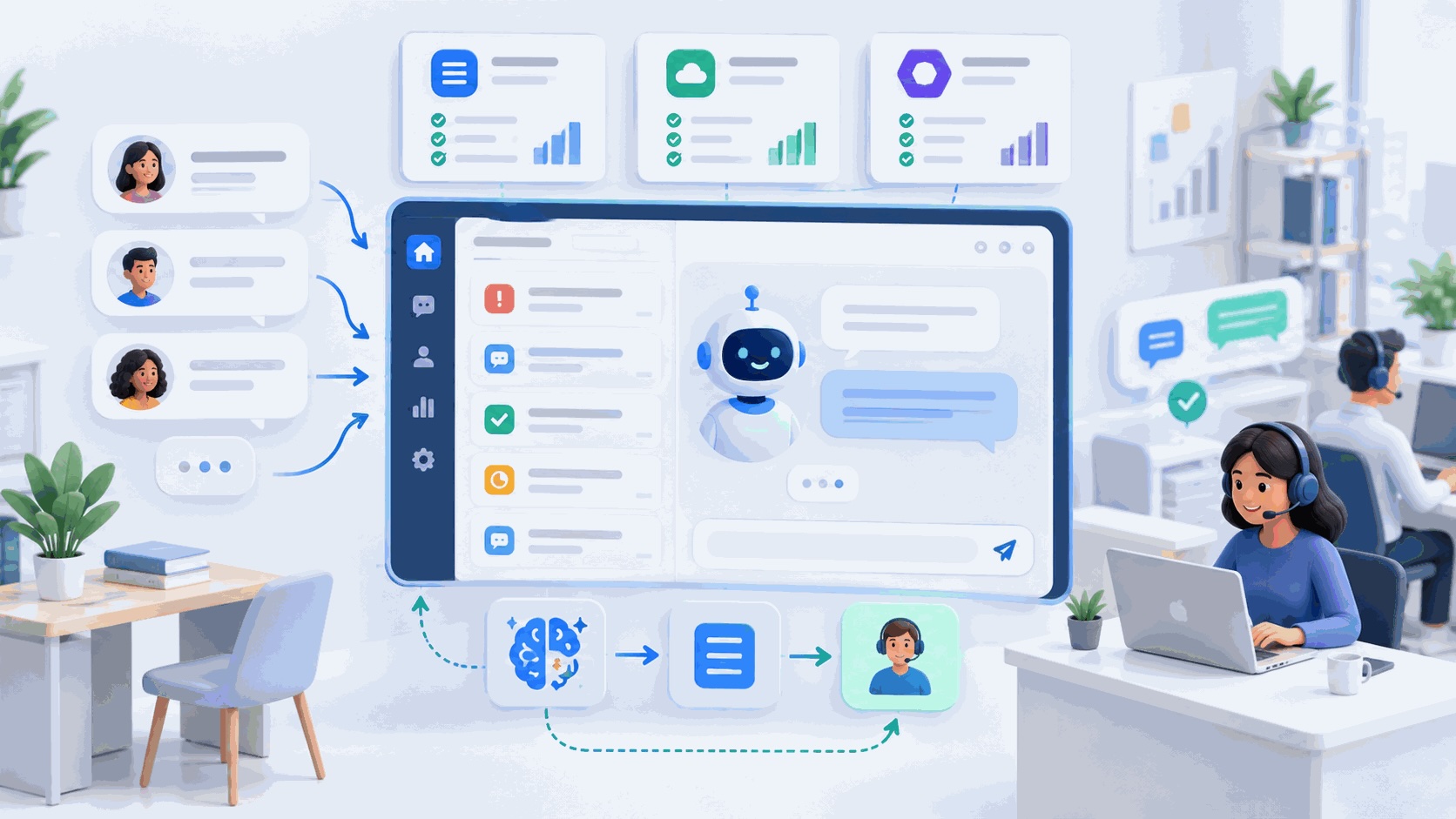
You have a time-consuming business process: an overwhelmed Level 1 help desk, repetitive accounting requests, RFPs to draft, and a customer service team that can’t keep up. You want to automate, but neither a generic Copilot nor a basic chatbot will do: you need something that understands your data and business rules and can operate within your information system.
This is where custom AI agents come into play: a combination of large language models (LLMs), data-driven search (RAG), your business rules, and integration with your IT systems. This is the level where, in the vast majority of cases, value is realized most quickly for small and medium-sized businesses.
Price: starting at €5,000 (excluding tax) for a targeted module. A module refers to a specific use case: a helpdesk agent who handles Level 1 tickets, an agent who qualifies incoming leads on your website, or an agent who drafts responses to requests for proposals based on your database. The price then increases based on the number of modules, the complexity of the system to be integrated, and the quality of the initial knowledge base.
Two concrete examples, with figures
Helpy—our AI help desk agent. We tested it on our internal IT infrastructure before offering it to our clients. Before: 270 hours of Level 1 support per month, with 15 technicians overwhelmed by repetitive questions. After 11 months in production: 141 hours per month— a savings of 129 hours each month. Zero layoffs: 9 to 10 technicians redeployed to handle actual incidents and client projects. Among our clients today, 60% of Level 1 tickets are closed without human intervention, based on data from June through August 2026 across 55 clients under contract.
Our POC on competitive bids. It used to take us four days to prepare the technical proposal for a bid. With an agent leveraging our successful bids, we’ve cut that time to two hours. The direct result: a 40% increase in proposals submitted and a 22% increase in revenue in the relevant market. No layoffs—just a more efficient use of sales time.
In both cases, the return on investment is measured in months, not years. That’s what makes Level 3 so profitable: the ratio between its cost and the time it takes to pay for itself.
Level 4 — Advanced Development: €30,000 to €90,000 for your business software
You have a core business function that no standard SaaS solution adequately addresses. You’re cobbling together solutions in Excel, or using a generic tool that’s ill-suited to your needs and wastes your time every day. This is your unique selling point—the 20% that truly sets you apart from your competitors—and it’s precisely where off-the-shelf tools fall short.
Historically, having custom software developed for that 20% cost between €150,000 and €500,000 over 24 months or more—a price out of reach for most small and medium-sized businesses. AI has broken down this barrier: today, we can build the same software for €30,000 to €90,000 in 6 weeks to 90 days, thanks to a method that captures your business processes directly from your existing software and files, eliminating the specification workshops that used to consume the bulk of the budget and time.
Price: €30,000 to €90,000 (excluding tax) for the first version, depending on the complexity of the business and the scope of the project. Once the first version is delivered, you own the code, you manage the hosting, and future updates are handled independently: you are no longer dependent on a SaaS provider.
A real-world example: Obeevi
Obeevi is a video production agency we worked with. Before: tracking in Excel, scattered information, forgotten follow-ups, and standard CRMs ill-suited to the video industry. After our custom development: a bespoke CRM integrating the stages of video production, delivered in 22 days from concept to production. Obeevi owns the code, manages the hosting, and can update the system independently.
3. Expected expenses
Regardless of the level, the cost of an AI agent isn't limited to implementation. Several budget items are often underestimated during the scoping phase.
Development and integration. The most visible component: architecture, API connectors, workflows, and training the agent on your data. This typically accounts for 40 to 60 percent of the initial budget. Connecting an agent to legacy systems (outdated ERPs, undocumented databases, proprietary APIs) can drive up integration costs, which is why an architectural audit is essential before any cost estimates are made.
Infrastructure and hosting. Cloud servers (Azure, AWS, GCP, OVHcloud), vector databases, log storage. Expect to pay between €50 and €300 per month for moderate cloud volumes. On-premises hosting, required in certain regulated sectors (banking, healthcare, defense), involves a higher initial investment but provides full control over data.
LLM token consumption. Each request consumes tokens billed by the provider (Anthropic, OpenAI, Mistral, Google). API rates in 2026 range from about $1 to $5 per million input tokens and $5 to $25 per million output tokens for state-of-the-art models, while lightweight models (such as “Flash” or “Haiku”) cost fractions of a dollar. In practice, an agent often processes a request for just a few cents. Prompt caching reduces the cost of repetitive requests by up to 90%.
Ongoing maintenance and optimization. An AI agent isn’t a “one-time” project: analyzing failed conversations, enriching the knowledge base, adjusting prompts, and upgrading models. Set aside 10 to 20% of the initial budget each year. It is this optimization that enables an agent to achieve a 60% autonomous resolution rate.
Team training. Often overlooked: your teams need to learn how to work with the agent. Change management, internal documentation, onboarding.
4. Market pricing models
Understanding these models is essential for forecasting your costs and avoiding unpleasant surprises.
License (SaaS). A fixed monthly subscription that includes a quota of interactions or features. This is the approach taken by packaged solutions (Intercom, Zendesk AI, Crisp). Predictable budget, limited customization.
Pay-as-you-go. You pay for actual usage: per conversation, per action, or per credit. Salesforce Agentforce, for example, launched a $2-per-conversation model, which has since been supplemented with credits per action and user licenses. A key concern raised by many CIOs: billing per conversation means paying for failures as well. With a 60% resolution rate, a $2/conversation model actually amounts to about $3.33 per case actually resolved. “Per-resolution” models (Intercom Fin, Zendesk, HubSpot) only charge for successful resolutions.
Customized (fixed-price or time-and-materials). A fixed-price contract sets the price in advance based on a defined scope of work—this is the approach we prefer at IT Systèmes, for transparency and budget control. Time-and-materials billing is based on hours worked and is better suited for exploratory projects.
Hybrid. An upfront development fee combined with a monthly subscription for maintenance, support, and tokens. This is the model we recommend: the best balance between predictability and flexibility.
5. Hidden costs you shouldn't overlook
The technical cost of integration. Connecting an agent to legacy systems (outdated ERP systems, undocumented databases, proprietary APIs) can double or triple the integration budget. An audit of your existing IT architecture is essential before any cost estimates are made.
The token explosion. A poorly optimized agent (with overly long contexts, no caching, or an oversized model for simple tasks) can see its token cost increase fivefold. Optimizing prompts and choosing the right model for each task are key ways to reduce costs.
Regulatory compliance. GDPR, NIS2, ISO 27001, AI Act: depending on your industry, compliance can add 10 to 30% to your budget. Sovereign hosting, encryption, audit trails, security testing—these are non-negotiable in regulated industries, yet often missing from quotes provided by less scrupulous service providers. We cover this topic in detail in our guide on how to secure an AI agent project.
The cost of "doing nothing." The most insidious mistake: failing to automate. An employee who spends four hours a day on tasks that an agent could handle in a matter of seconds represents a significant opportunity cost in terms of time, responsiveness, and competitiveness.
At what point does an AI agent become profitable?
The answer depends on your use case, the volume of interactions, and the current cost of manual processing. With a custom-built agent (Level 3), the return on investment is measured in months, not years, as our internal data shows: Helpy reduced our support hours from 270 to 141 per month, and the POC for RFPs generated a 40% increase in proposals and a 22% increase in revenue. For a comprehensive industry-specific software solution (Level 4), the ROI depends on the criticality of the tool, viewed as a long-term asset that you own.
A key point: ROI improves over time. An agent’s performance improves as their knowledge base matures: the rate in the first few months is not the same as the steady-state rate. Every point gained reduces the unit cost.
The AI agent doesn't replace your teams—it frees them from repetitive tasks so they can focus on what requires empathy, judgment, and creativity. To learn more, see our productivity gains by industry.
Why We Display Our Prices
Many digital services firms don’t publish their rates, so they can tailor quotes to each client’s perceived budget. We prefer to provide clear price ranges up front, so you know we’re on the same page even before we meet. If you have a budget of €8,000, you’ll know right away that you’re looking at our targeted Level 3 plan—not a full-scale development project. And if your needs can be met with a simple Level 1 solution at €5 per user per month, we’ll let you know—that’s what we do in 4 out of 10 cases, saying no to custom solutions when a simpler answer exists.
How to identify your needs in 4 questions
- Want to help your teams make the most of ChatGPT and other consumer-grade AI tools? Level 1. Starting at €5 per user per month; get started in just a few days.
- Want to deploy Microsoft 365 Copilot without putting your data at risk? Level 2. €1,500 for the audit, plus the cost of Copilot licenses.
- Are you looking to automate a specific business process (support, sales, HR, accounting)? Level 3. Starting at €5,000 for a targeted module, 4 to 12 weeks.
- Do you want to replace a line-of-business application or build one that no one else sells? Level 4. €30,000 to €90,000 for the first version, 30 to 90 days.
If you're torn between two levels, the right choice is probably the lower of the two. You can always move up to a more advanced level later, as you gain confidence in the material.
Frequently asked questions
How much does an AI agent cost for an SME?
It all depends on what you mean by “AI agent.” For consumer-grade AI like ChatGPT: starting at €5 per user per month. For a truly customized agent connected to your data that performs actions within your IT system: starting at €5,000 for a targeted module. For a complete business application that includes AI: €30,000 to €90,000 for the initial release. The determining factor isn’t the size of your company—it’s the nature of your needs.
Why is there such a big difference between €5,000 and €90,000?
Because we’re not talking about the same thing. For €5,000, you’re buying a module: an agent that performs a specific task (responding to simple tickets, qualifying leads), connected to your IT system. For €90,000, you build a complete, custom-made business application: your digitized core business, with your own code, your own hosting, and the ability to make independent updates. That’s the difference between buying a feature and building an asset.
Is the AI agent free?
Some solutions offer limited free versions (OpenAI’s Custom GPT, Google’s NotebookLM). But for professional use—with system integration, data security, and guaranteed performance—an investment is unavoidable. Free solutions are meant for testing a concept, not for deployment in production.
Are there any recurring fees in addition to the setup fee?
Yes, mainly two areas. The use of AI models (Claude, GPT, Gemini, Mistral), billed on a pay-as-you-go basis: a marginal but real cost, always included in the initial quote. And hosting, monitoring, and maintenance—depending on whether you manage these yourself or entrust them to us.
How long does it take to see a return on investment?
For a custom agent (Level 3), ROI is calculated in months. Our internal examples: Helpy reduced our support hours from 270 to 141 hours per month; the RFP proof of concept generated a 40% increase in proposals and a 22% increase in revenue within the scope of the project. For a comprehensive business software solution (Level 4), the ROI depends on the tool’s criticality, as it is viewed as a long-term asset that you own.
Can we start small and expand later?
This is what we recommend in almost all cases. Start with a module focused on a single use case, measure its value over a few months, and then scale up once you’ve established confidence. Starting out too ambitiously without having proven the value is the surest way to derail a project.
How can the cost of an AI agent be reduced?
Start with a targeted POC, use the right LLM model for each task (a lightweight model for sorting, a powerful model for reasoning), leverage prompt caching (up to 90% savings on repetitive queries), share infrastructure across multiple agents, and choose a partner who clearly defines the project scope from the outset.
How much does an AI automation agency service cost?
Prices vary widely. Large digital agencies often charge by the hour, with quotes that can range from one-third to three times the price for identical projects. Specialized firms generally offer more transparent flat-rate pricing, with a commitment to results. For a reliable estimate, a preliminary assessment is essential.
How do I know if I don't need an AI project at all?
We’ll be honest with you. In 4 out of 10 meetings, we advise against custom solutions: either an off-the-shelf tool is sufficient, the need isn’t fully developed yet, or the organization isn’t ready to embrace the change. AI amplifies your strengths but exposes your weaknesses: if you’re not ready to make changes to the organization, it’s better to postpone the project.
How much does an AI project cost? Between €5 per month and €90,000 for the first version, depending on the scope. These four price ranges cover the vast majority of cases we encounter.
What these prices reveal above all is that the economic barrier to custom solutions has been broken. In the past, specialized software or an AI agent was out of reach for most small and medium-sized businesses. Today, a targeted module starts at €5,000, and a full-featured software package costs less than €90,000 for the initial version. The question is no longer “Can I afford it?” but “Where are my real bottlenecks, and how much does it cost me to do nothing?”
The actual figure, however, always depends on your specific situation—that’s something we calculate together during a workshop, not in a blog post. Learn more about our AI agents for businesses and our real-world business use cases.
Request a preliminary assessment—get a personalized estimate within 48 hours.






.svg)