.svg)

Key Takeaways
- At an accounting firm, an AI agent handles the collection and entry of documents, bank reconciliation and account matching, pre-audit review, and the preparation of financial statements.
- It integrates with the firm's accounting software (Cegid in this article): there's no need to switch to a different one.
- It is up to the certified public accountant to exercise judgment, verify the statements, and provide advice.
- Since September 1, 2026, electronic invoices have been arriving in a pre-formatted format: OCR processing is less burdensome, while verification and exception handling take on greater importance.
- The gain is measured based on your cases during a pilot, not as a generic percentage.
- Budget: from €5,000 (excluding tax) for a single-agent solution to €30,000 (excluding tax) for a multi-agent solution.
Automation of Accounting Processes: What an AI Agent Does in an Accounting Firm
In a law firm, a significant portion of employees’ time is spent on tasks that follow established rules: entering documents, reconciling statements, sending follow-up reminders, and formatting reports. This is the kind of work that an AI agent can take over.
He does not replace the certified public accountant. He handles the day-to-day work, while the firm handles consulting, analysis, and client relations.
This article explains what an AI agent can automate in an accounting firm, how it integrates with Cegid, and how to measure its actual impact.
1. Tasks that are best suited for automation
An AI agent is effective at high-volume tasks that are governed by clear rules and require little judgment. In a law firm, these tasks fall into four categories.
Collection and Entry of Documents
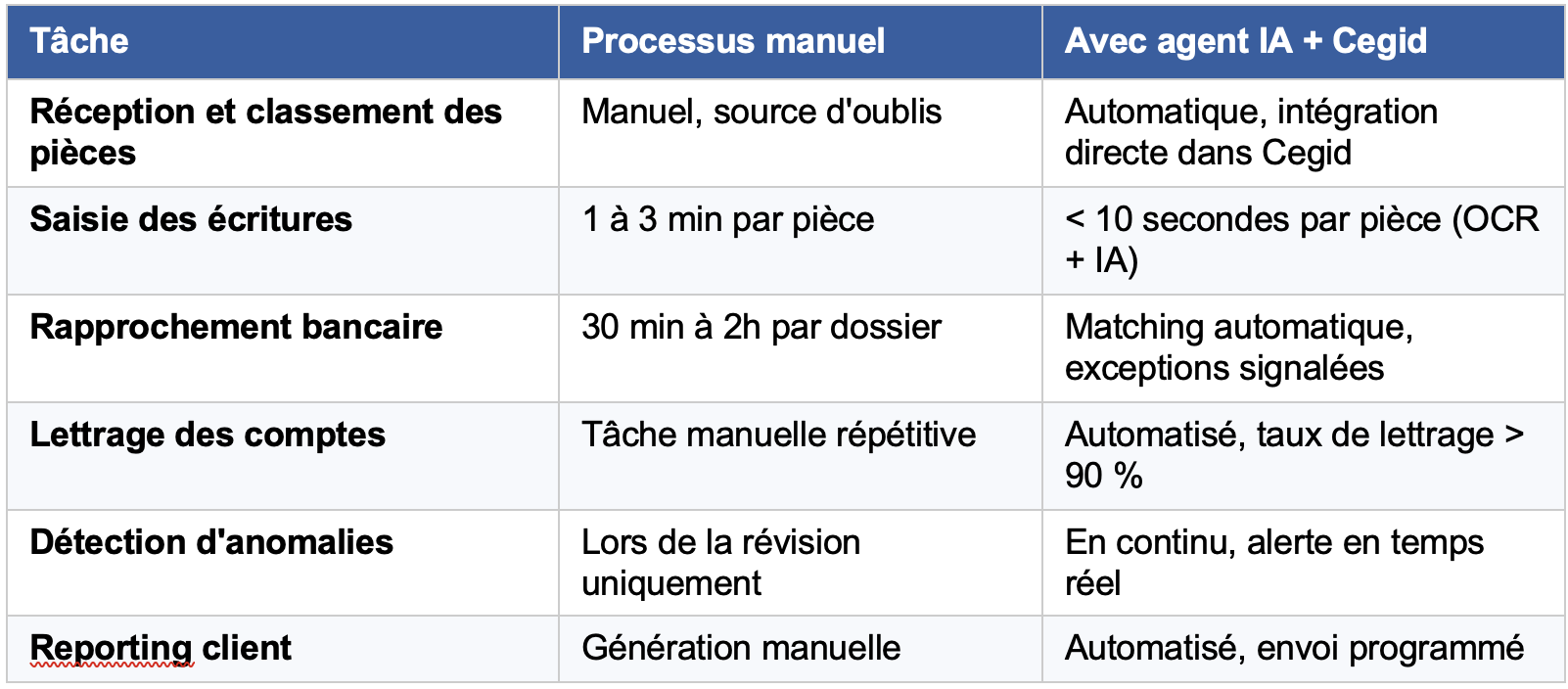
Supplier invoices, expense reports, bank statements: The agent retrieves the documents wherever they arrive (email, customer portal, scanned copies), extracts the data, files them by type and folder, and then prepares the journal entries in Cegid.
In this regard, electronic invoicing is bringing about significant changes. As of September 1, 2026, all businesses must be able to receive electronic invoices, which are already formatted in Factur-X, UBL, or CII. OCR extraction remains useful for PDFs from suppliers who will not issue electronic invoices until September 2027, for foreign invoices, and for expense report receipts. Otherwise, the focus is shifting toward verification and handling exceptions. The IT aspects of the reform are covered in our article “Electronic Invoicing and PDP: Preparing Your Accounting Firm’s IT,” and what it means for an AI agent in “Accounting AI Agent: What It Does Since the Introduction of Electronic Invoicing.”
Bank reconciliation and lettering
The agent imports the statements, reconciles the transactions with the journal entries, and reports only the exceptions to the employee: unreconciled entries, suspected duplicates, and inconsistent amounts.
The reconciliation of accounts receivable and accounts payable follows the same process, based on the rules defined for each file. The rate of automatic reconciliation depends mainly on how well the file is maintained. In a well-organized file, the agent can reconcile most of it on their own; in a file that has been poorly reconciled for years, it must first be brought up to order.
Pre-inspection before overhaul
The agent checks the consistency of the entries as they come in and flags anything out of the ordinary: atypical amounts, accounts with unusually high transaction volumes, or significant discrepancies compared to previous fiscal years. The employee arrives at the review with a file that has already been thoroughly reviewed and a list of points to examine.
Customer declarations and reporting
Preparation of VAT documents, reconciliation of revenue and VAT, and periodic reporting: the agent prepares these documents, submits them for approval before they are sent, and tracks the filing deadlines for each case.
2. Overview: Manual Process and AI Agent with Cegid
Is your firm wasting time?
Processes to Automate:
as a Priority in Your Practice
Data entry, bank reconciliation, account reconciliation, VAT, reporting. Let's talk about it.
3. What an AI agent does not do
An AI agent is not a certified public accountant. It does not make professional judgments, does not advise the client, and does not make decisions in situations of uncertainty. The following remain entirely human:
- financial analysis and consulting;
- complex or contentious tax situations;
- customer relations and financial reporting;
- final approval of the declarations;
- any decision that requires interpreting the standard or the client's context.
The agent carries out the work, while the certified public accountant retains the authority to make judgments and assumes responsibility. It is this division of roles that makes the model ethically acceptable.
4. Integration with Cegid
The agent connects to Cegid to read and write accounting data, without requiring a system overhaul. The connection method depends on the version of Cegid used by the firm and the modules it has subscribed to. This is verified during the scoping phase, before any commitment is made.
A deployment generally includes:
- the connection between the agent and Cegid;
- an extraction module for documents that are not received in electronic format;
- a storage area for supporting documents;
- a monitoring dashboard for employees and partners.
The agent’s access rights are defined on a case-by-case basis: he or she sees only what is necessary. The hosting location, the AI model used, and the retention period for documents must be specified in writing before the project begins. For a firm bound by attorney-client privilege, these are the first questions to ask, and they require precise answers.
The quality of the source data
The system is only as good as the data it receives. A poorly structured chart of accounts, historically inconsistent journal entries, or illegible scans can compromise the results. The quality of the data is therefore reviewed before any deployment.
5. ROI: How Much an Agent Brings in for a Firm
Return on investment depends on two factors: the time saved per employee, and the number of additional cases the firm can handle without hiring additional staff.
Measure the gain rather than just announcing it
There are many claimed percentage gains per task, but they are rarely accompanied by the timeframe, volume, or methodology needed to verify them. They say very little about your specific cases. We prefer to measure performance during the pilot: average time per document before and after, the percentage of documents processed without human correction, and entries corrected during review. The results are reported on a task-by-task basis.
Calculate the figures for your practice
The calculation fits on one line. Number of parts per month × 12 × minutes saved per part ÷ 60 equals the number of hours per year. Multiplied by the employee’s hourly rate, this figure can be compared to the project’s price and its operating costs. With 1,000 parts per month and 2 minutes saved per part (an estimate—substitute your own figures), this amounts to 400 hours per year.
The payback period is derived from this calculation. It depends too much on volume and record-keeping practices for a generic range to be meaningful.
6. Where to Start
The most common mistake is trying to automate everything at once. It's better to start with a limited scope, verify the benefits, and then expand.
Step 1: Process Audit
Mapping of repetitive tasks by volume and time spent, automation potential for each task, status of data in Cegid, and selection of the initial scope.
Step 2: Pilot the process
The agent is deployed for a clearly defined process, typically data entry or bank reconciliation. Performance gains are measured under real-world conditions, and the agent is fine-tuned based on employee feedback. The duration of the pilot depends on the number of data sources to be connected; it is determined at the conclusion of the audit.
Step 3: Extension
Once the initial process has stabilized, the tool is expanded to include review, reporting, and the preparation of filings. Each expansion is measured in the same way.
How much does it cost?
Expect to pay between €5,000 (excluding tax) for a single-task agent and €30,000 (excluding tax) for a multi-agent solution that covers multiple processes. Details on the cost components can be found in “How Much Does an AI Agent Cost for a Business?”
Our teams support firms from the audit phase through to production deployment. Each project begins with an audit of your processes and information system.
IT Systèmes automates your accounting
Without changing your accounting software
The agent will connect to your production system. Let's discuss your files.
Frequently asked questions
Is accounting automation compatible with the ethical obligations of certified public accountants?
Yes. The AI agent handles the execution. Professional liability, the validation of financial statements, and client advising remain entirely the responsibility of the certified public accountant. The implementation does not change the firm’s structure of responsibility.
Is it necessary to change accounting software to deploy an AI agent?
No. The agent connects to the existing software, and the connection method is determined based on your version of Cegid. The firm retains its tools, approval processes, and organizational structure.
Is customer data protected?
Be sure to review the following points one by one before signing: hosting location, AI model used, data retention period, access rights by file, and agent activity log. Request a written response for each one. See also: How to Secure an AI Agent Project in a Business Setting.
Does electronic invoicing make AI agents obsolete?
No, it shifts the focus. Invoices received through an approved platform are already formatted, so reviewing the documents takes less time. Invoice verification, reconciliation, itemization, and non-compliant documents (expense reports, foreign invoices, PDFs from suppliers not yet required to issue electronic invoices) still need to be processed.
How much does an automation project cost for an accounting firm?
From €5,000 (excluding tax) for a single-agent solution to €30,000 (excluding tax) for a multi-agent solution, depending on the number of processes covered. An exact quote is provided after the audit, once the scope has been determined.
Would you like to assess the automation potential of your firm?
We conduct an audit of your accounting processes and present you with the potential savings and an implementation plan tailored to your firm. Contact us.
See our services:






.svg)