.svg)

Key Takeaways
- An AI audit automatically analyzes an IT system's infrastructure, assets, configurations, logs, and security flows to identify vulnerabilities, outdated components, and blind spots.
- Whereas a manual audit relies on sampling, an AI audit processes all the data and identifies weak signals that are difficult for humans to detect in large volumes.
- AI speeds up and expands the scope of analysis. Experts remain essential for interpreting the results, filtering out false positives, and prioritizing actions.
- The useful deliverable is not a raw list of alerts, but an action plan prioritized by risk and effort.
- An AI audit is typically initiated after an incident, during a growth phase, before a migration, or when performance issues accumulate without an identified cause.
Auditing an information system manually means examining a sample. You inspect a few servers, check a subset of workstations, review the logs from the past few weeks, and extrapolate. With a fleet of fifty workstations and a handful of servers, this approach still works. Beyond that, blind spots multiply—and it’s often in these overlooked areas that the real problem lies. AI auditing changes the scale of what we can examine.
What is an AI audit of an information system?
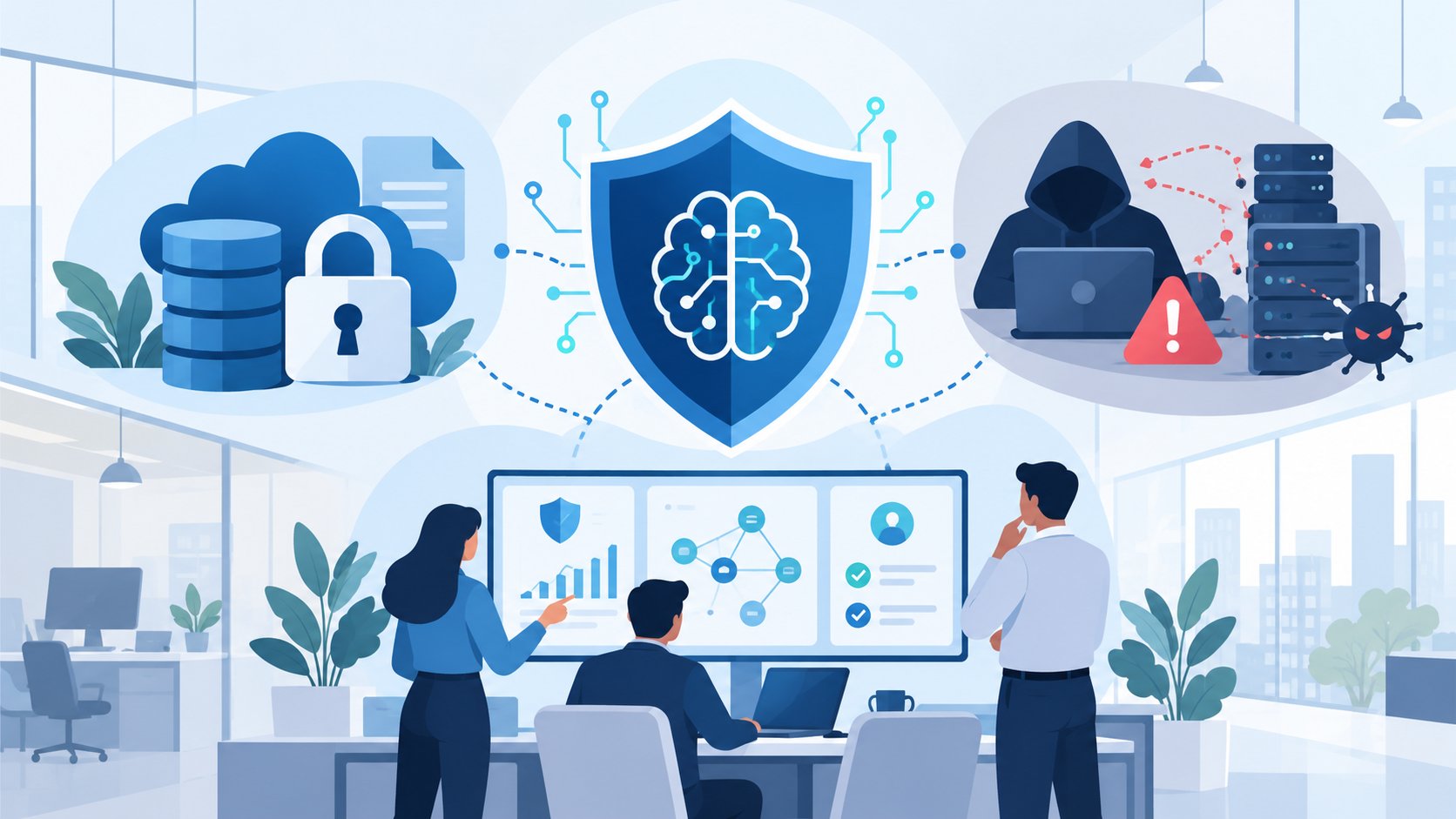
An AI audit relies on models capable of ingesting and correlating large volumes of technical data to generate a diagnosis. AI does not replace the audit process; it enhances it. Specifically, it processes four main categories of data: asset and configuration inventories, activity and security logs, network traffic, and the status of software patches and versions.
In each case, the benefit is the same: comprehensiveness and correlation. A human reading logs looks for what they already know. A trained model, on the other hand, identifies unusual combinations, deviations from the norm, and sequences of events that seem innocuous when taken in isolation but, when viewed together, signal a risk. It is this ability to connect scattered signals that distinguishes an AI audit from a simple automated scan.
What exactly does the scope of an AI audit cover?
A thorough AI audit is not limited to a single area. It covers all layers of the information system, because vulnerabilities often arise at the intersection of two of them.
Infrastructure and network: servers, equipment, topology, incoming and outgoing traffic, segmentation. AI identifies risky configurations and abnormal communications within this environment.
The IT infrastructure and workstations: system versions, patch status, installed software, and compliance with internal policies.
Identities and access: active accounts, dormant accounts, excessive permissions, access that has never been revoked. This is one of the most common entry points.
The Cloud and Applications: Hosted Service Configurations, Open Sharing, and Dependencies Between Business Applications.
Security data: authentication logs, intrusion attempts, and anomalous behavior.
A manual audit would struggle to cover this scope within a reasonable timeframe. AI processes these layers in parallel and cross-references their signals, bringing the diagnosis closer to a truly comprehensive view of the information system.
What an AI audit detects better than a manual audit
Three areas benefit particularly from this approach.
Security vulnerabilities first. Across thousands of lines of configuration and log data, the AI audit identifies exposed versions, open ports, dormant accounts, and connection anomalies, whereas a manual review focuses on already known issues. This analysis directly addresses an IT system’s cybersecurity and compliance challenges.
Next, obsolescence. Systems at the end of their support lifecycle, unmaintained software, aging dependencies: AI creates a comprehensive map of technical debt, including its level of criticality, which directly informs an IT system modernization strategy.
Finally, the blind spots. These are the elements that no one monitors because no one knows they exist: a forgotten server, an access point that’s never been disabled, an undocumented data stream. This is often where the real risk lies, and it’s precisely what a comprehensive audit uncovers when a sample-based audit misses it.
What is the step-by-step process for an AI audit?
An AI audit follows a four-step process. The basic approach is the same as that of a traditional audit; it is the depth of analysis that differs.
First, data collection: we connect the information system’s data sources (inventory, logs, configurations, data flows) within a confidentiality framework defined in advance. Next comes automated analysis: models process all the data, detect anomalies, and correlate signals across layers. Then comes expert interpretation: a specialist sifts through the results, filters out false positives, and evaluates each finding in light of your business context. Finally, the output: a prioritized action plan, not just a raw list of alerts.
This workflow shows where AI takes over and where humans step in. Automation covers data collection and analysis; the final value lies in interpretation and presentation.
The Limits of AI Auditing: Why Experts Are Still Indispensable
AI generates a large volume of signals. Not all of these signals are relevant. An AI audit delivered without interpretation is an avalanche of alerts, many of which are false positives or theoretical risks with no real impact on your specific context. The value doesn’t come from raw detection; it comes from filtering.
That’s the expert’s role: to filter out the noise, understand what really matters to your business, and prioritize. A critical vulnerability on an isolated server with no sensitive data carries far less weight than a moderate vulnerability on the system that hosts your billing. AI cannot perform this prioritization based on business risk on its own—it requires the context that only a human possesses. This is also why an AI audit is most often part of a consulting process rather than the delivery of an automated report.
From Analysis to Action Plan
The proper outcome of an AI audit is not a list of issues. It is a prioritized action plan that takes two factors into account: the level of risk and the effort required to address the issues. This framework helps distinguish between what needs to be addressed immediately, what can wait, and what is not worth the cost of correction.
This approach to prioritization is the same as for any structured digital initiative: you start by addressing what offers the best impact-to-effort ratio, and then you expand. That’s what sets a useful audit apart from a report that ends up in a drawer.
When should you conduct an AI audit of your IT system?
There are certain times when this is particularly warranted. After a security incident, to understand the true extent of exposure beyond the visible vulnerability. During a growth phase, when the IT system has expanded through accumulation and no one has a clear overview anymore. Before a migration or modernization, to start with a reliable assessment of the current state rather than assumptions. Or simply when slowdowns and malfunctions pile up without a clearly identified cause—a sign that the problem lies in an unmonitored area.
In all these cases, the value of an AI audit lies in its ability to quickly provide a comprehensive overview, whereas a manual assessment would take weeks to yield even partial results.
Frequently Asked Questions
Does an AI audit replace a human auditor?
No. AI processes large volumes of data and identifies correlations, but interpretation, filtering out false positives, and prioritizing based on business risk remain the responsibility of the expert. AI auditing is a catalyst, not an autonomous auditor.
How long does an AI audit take?
Automated analysis of technical data is much faster than an equivalent manual review—often taking just a few days, whereas a traditional, comprehensive audit would take weeks. This frees up time for interpretation and developing an action plan.
Is my data exposed during the AI audit?
It depends on the approach chosen. A thorough audit establishes guidelines in advance regarding confidentiality, the hosting of analyzed data, and its deletion after processing. This is an issue that needs to be clarified before getting started, just as the scope does.
What is the difference between an AI audit and a traditional vulnerability scan?
A scanner looks for known signatures. An AI audit goes a step further: it correlates signals from multiple sources, detects behavioral anomalies, and highlights blind spots that no signature covers.
How often should you audit your information system?
Beyond one-time triggers (incidents, growth, migration), a regular audit—such as an annual one—makes it possible to track changes in technical debt and the level of exposure. The speed of the AI audit makes it easier to maintain this frequency than with a fully manual audit.
.png)





.svg)