.svg)
Salesforce and HubSpot now include AI modules in their standard offerings. The problem is that these modules are designed for thousands of companies at once. They don’t understand your pipeline stages, your recurring objections, or your sales cycle. The typical result: features pile up, the cost per user rises, and the sales team doesn’t use the tool.
A growing number of small and medium-sized businesses are opting for custom-built CRM systems with AI configured to work with their own data. Costs are lower over a 3- to 5-year period, and adoption rates are consistently higher. This guide explains why, backed by statistics.
1. What "AI CRM" Really Means in 2026
The term "AI CRM" has become a marketing buzzword. Almost all SaaS solutions tout it. In reality, however, what lies behind this label varies greatly from one vendor to another.
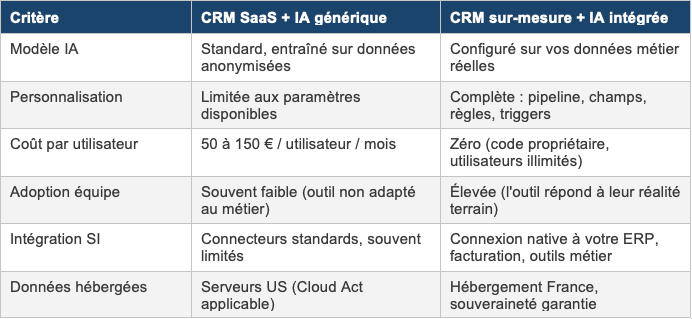
SaaS CRM with integrated AI vs. Custom CRM with native AI
In most SaaS CRMs, AI is simply an additional layer built on top of an existing tool: lead scoring based on generic models, pre-formatted email suggestions, and standardized call summaries. These features can be useful, but they’re designed to serve thousands of customers at once—not your specific sales process.
A custom CRM works differently. The AI is configured using your data: your pipeline, your common objections, and your actual sales cycle. It offers actions tailored to your specific situation, not generic suggestions.
2. The 5 AI use cases that make a difference for an SME
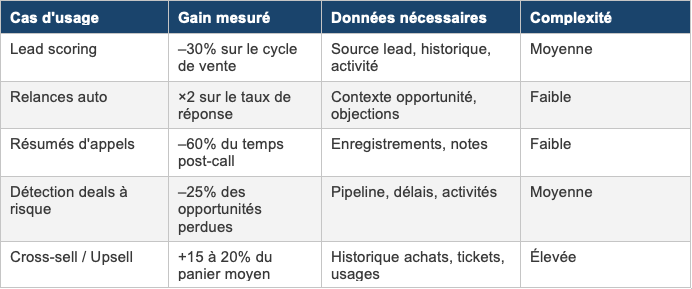
AI frees up the time your teams spend on tasks that don’t drive business results: entering data into the CRM, drafting follow-up emails, categorizing leads, and preparing for calls. Here are the five use cases that deliver the most measurable results for small and medium-sized businesses.
1. Automated lead scoring
An AI-powered CRM calculates a priority score based on the prospect’s profile (industry, company size, role) and behavior (pages visited, emails opened, demo requests). Sales reps no longer treat all leads the same way.
Out of 200 incoming leads per month, AI-powered lead scoring focuses 80% of sales efforts on the 30 to 40 most qualified prospects. The sales cycle is shortened by an average of 30%.
2. Personalized follow-ups
The AI drafts an initial follow-up email based on the context of the opportunity: the last interaction, any identified objections, and the stage of the sales pipeline. The sales rep reviews, edits, and sends it. What used to take 15 minutes now takes just 2.
3. Summary of Calls and Next Steps
After each customer call, the AI transcribes, summarizes, and suggests next steps in the opportunity record. Notes no longer remain in a notebook or in the sales representative’s memory.
4. Identifying risky deals
When a deal remains inactive for three weeks, the AI alerts the sales representative before contact is lost. A traditional CRM system simply logs the issue. An AI-powered CRM system flags it in a timely manner.
See also: 24/7 AI Agent for SMEs: A Guide to Getting Started
5. Cross-sell and upsell recommendations
For existing customers, AI analyzes purchase history, support tickets, and usage patterns to identify relevant complementary offers. The average order value increases without any additional sales pressure.
3. Case Study: A Custom CRM Replaces Salesforce
In 2025, IT Systèmes supported a company with 50 users as it replaced Salesforce with a custom AI-powered CRM. The before-and-after figures are detailed below.
Starting point
• 50 users on Salesforce Sales Cloud
• Annual cost: €90,000 (licenses + additional AI modules)
• Adoption rate: 58%. Sales reps were bypassing the tool
• Faulty integrations with the internal ERP system
• Data hosted in the United States (Cloud Act)
Solution developed by IT Systèmes
• Custom CRM developed in less than 50 days
• Built-in AI: scoring, follow-ups, call summaries, pipeline alerts
• Full integration with the ERP system, invoicing, and business tools
• 100% French hosting
• Unlimited users, zero licensing costs
Results after 12 months
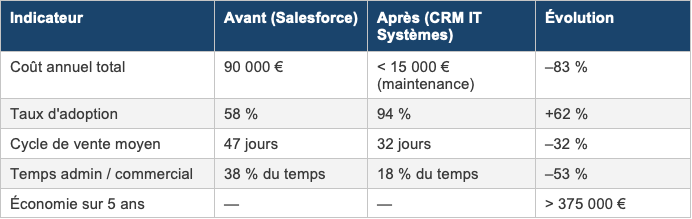
Over a five-year period, switching from a SaaS CRM to a custom CRM can save an SME with 50 users between €250,000 and €400,000, not including gains in sales productivity.
Learn more: Custom software development: methodology, timelines, and budget
4. Why the "best AI CRM" isn't the one you think it is
Online comparisons rank Salesforce, HubSpot, and Pipedrive at the top. These rankings reflect their suitability for large companies with dedicated RevOps teams and substantial budgets.
For an SME with 10 to 200 employees, the priorities are different:
• A CRM that your teams actually use, not a tool that’s forced on them
• AI tailored to your industry, not generic AI
• Total costs kept under control over 3 to 5 years, rather than rising costs per seat
• Data hosted in France to ensure compliance with the GDPR and NIS2
• Native integration with your existing IT system, not unreliable connectors
The Three Most Common Mistakes When Choosing an AI-Powered CRM
Mistake 1: Choosing the most well-known option rather than the most suitable one
Choosing the most well-known CRM rather than the one that best fits your needs. A platform’s popularity does not guarantee that it’s the right fit for your business. Many small and medium-sized businesses leave Salesforce after 18 months—not because the tool is bad, but because it wasn’t configured to meet their specific needs.
Mistake 2: Underestimating the actual cost
Underestimating the actual cost. The price listed on a SaaS CRM’s website is rarely the final cost. Add in add-ons, training, integrations, and dedicated support, and the bill often doubles—sometimes triples.
Mistake 3: Ignoring the issue of data
Set aside the data issue for now. NIS2 has taken effect, and the GDPR applies. Hosting CRM customer data on U.S. servers exposes the company to the Cloud Act, which authorizes U.S. authorities to access that data without prior notice.
5. How to Choose an AI CRM in 2026: The SME Checklist
Before choosing or upgrading your CRM, these eight questions will help you rule out options that don’t fit your situation.
8-Point Checklist
• Does the CRM fit my sales pipeline, or do I need to adapt my pipeline to the CRM?
• Is the cost fixed and predictable, or does it depend on the number of users?
• Is the data hosted in France? Am I compliant with the GDPR and NIS2?
• Does the CRM integrate natively with my ERP, invoicing system, and business tools?
• Is the AI trained on my data, or is it a generic model?
• Was my team involved in the decision? Is the adoption rate being tracked?
• Do I own the code and data, or am I dependent on a publisher?
• Is there a minimum contract term, or can I cancel without penalty?
Our Approach at IT Systèmes — IT Systèmes develops custom AI-powered CRM solutions for small and medium-sized businesses with 10 to 200 employees. Proprietary code, unlimited users, hosting in France, and delivery in less than 50 days. No monthly subscription.
6. Frequently Asked Questions
Is a custom CRM really cheaper than a SaaS solution?
In the first year, development costs can be comparable to the first year of a SaaS license. Starting in the second year, custom solutions are more cost-effective: there are no per-user fees and no additional modules. Over a five-year period for an SME with 50 users, the savings typically exceed €250,000.
How long does it take to develop a custom CRM?
IT Systèmes delivers CRM solutions for small and medium-sized businesses (starting at €30,000) in less than 50 days. Comprehensive CRM-ERP projects (starting at €90,000) are delivered in less than 100 days. Migration of existing data is included.
Is the AI in a custom CRM as powerful as Salesforce's?
It may not be more powerful in terms of raw models, but it is more precise: it is tailored to your data and your business. An AI that knows your 500 customers, your 12-step sales pipeline, and your 5 most common objections is more useful than a generic AI calibrated for 50,000 companies with no connection to your business.
How can you ensure GDPR compliance with an AI-powered CRM?
GDPR compliance depends on several specific decisions: hosting in France or the EU, a data processing agreement with the service provider, anonymization of data in AI prompts, defined retention periods, and the operational right to erasure. IT Systèmes incorporates these requirements right from the CRM design phase.
Can I integrate my CRM with Microsoft 365 and Teams?
Yes. IT Systèmes develops native connectors for Microsoft 365, Teams, Outlook, SharePoint, and Power Automate. Calendar events, Teams meetings, and Outlook emails are automatically synced to the CRM without the need for manual entry.
Do you have a CRM project? IT Systèmes develops custom CRM solutions powered by AI for small and medium-sized businesses. Proprietary code, unlimited users, hosting in France, and delivery in less than 50 days. No monthly subscription.
Discover our custom CRM solution







.svg)