.svg)
Hiring a marketing director on a permanent contract means a budget of €70,000 to €120,000 per year (salary + benefits), a recruitment process lasting 3 to 6 months, and no guarantee of immediate results. For an SME or mid-sized company that needs to structure its marketing strategy without blowing its budget, the equation is often impossible to solve.
It was precisely to address this constraint that the concept of the virtual marketing director was developed. Historically, the term referred to a freelance consultant who took charge of marketing strategy on a part-time basis. But in 2026, the model is evolving: the most advanced companies now combine an AI agent for operational execution (data analysis, campaign management, lead qualification, reporting) with occasional human supervision for strategic vision and high-stakes decisions.
Le résultat : une direction marketing complète, disponible 24/7, pour 3 à 5 fois moins cher qu'un recrutement classique, sans sacrifier ni la créativité ni le jugement humain. Dans cet article, nous détaillons ce que recouvre concrètement ce nouveau modèle de directeur marketing virtuel, ce que l'IA prend en charge, ce qui reste humain, et comment le déployer dans votre entreprise.
What is a virtual marketing director?
The classic definition: an outsourced CMO
Un directeur marketing virtuel, parfois appelé CMO virtuel ou directeur marketing externalisé, est un professionnel du marketing qui intervient à temps partiel pour une entreprise, sans être salarié. Il définit la stratégie marketing, pilote les prestataires (agence SEO, graphistes, rédacteurs), analyse les performances et ajuste le plan d'action.
Ce modèle présente des avantages évidents pour les PME : pas d'engagement salarial long terme, accès à un profil senior expérimenté, flexibilité d'intervention. Mais il a aussi ses limites. Un consultant humain facture entre 800 et 2 000 € par jour. À raison de 2 à 3 jours par semaine, on atteint rapidement 5 000 à 8 000 € par mois, sans compter la dépendance à une seule personne et sa disponibilité limitée.
The new definition: an AI agent serving marketing
In 2026, the virtual marketing director takes on a new dimension with the emergence of AI agents for businesses. Unlike a simple chatbot or traditional automation tool, an AI marketing agent is capable of understanding your business context, analyzing your data, making decisions, and executing concrete actions within your tools.
To fully understand this difference, it is helpful to read our article on the differences between an AI agent and a chatbot. A marketing chatbot answers predefined questions. An AI marketing agent drives your strategy.
What an AI marketing agent can actually do
Analyze your data and produce strategic recommendations
An AI marketing agent connects to your tools (Google Analytics, CRM, emailing platform, social networks) and continuously analyzes the performance of your actions. It identifies the most profitable channels, detects performance declines before they impact your results, and produces actionable recommendations.
Where a human marketing director spends half a day compiling dashboards, the AI agent generates a complete report in seconds, with actionable insights. This type of predictive analysis is one of the use cases that generates the most measurable productivity gains with AI agents.
Manage and optimize your marketing campaigns
The AI agent can manage the day-to-day operational execution of marketing:
- Email marketing: automatic segmentation of your database, creation of personalized sequences, continuous A/B testing, optimization of sending times
- SEO and content: keyword opportunity analysis, content creation suggestions, automated technical audit, ranking tracking
- Online advertising: real-time bid adjustment, budget allocation across channels, ad variation generation, performance reporting
- Social media: post scheduling, engagement analysis, identifying trends in your industry
Qualify your leads and feed the sales pipeline
This is one of the most requested use cases by our customers: the AI agent analyzes each incoming lead (form, contact request, white paper download), qualifies it according to your criteria (company size, sector, budget, urgency of need), and automatically directs it to the right sales representative with a contextualized brief.
The result: your salespeople no longer waste time on unqualified leads, and your hot prospects are contacted in minutes instead of hours. Our AI agents for businesses page details this use case for lead qualification in greater depth.
Producing marketing content at scale
The AI agent can generate initial drafts of content (blog articles, LinkedIn posts, newsletters, product sheets) in line with your editorial guidelines and tone. A human writer then steps in to validate, enrich, and contribute their professional expertise—but production time is reduced by a factor of 3 to 5.
Human virtual marketing director vs. AI agent: comparison
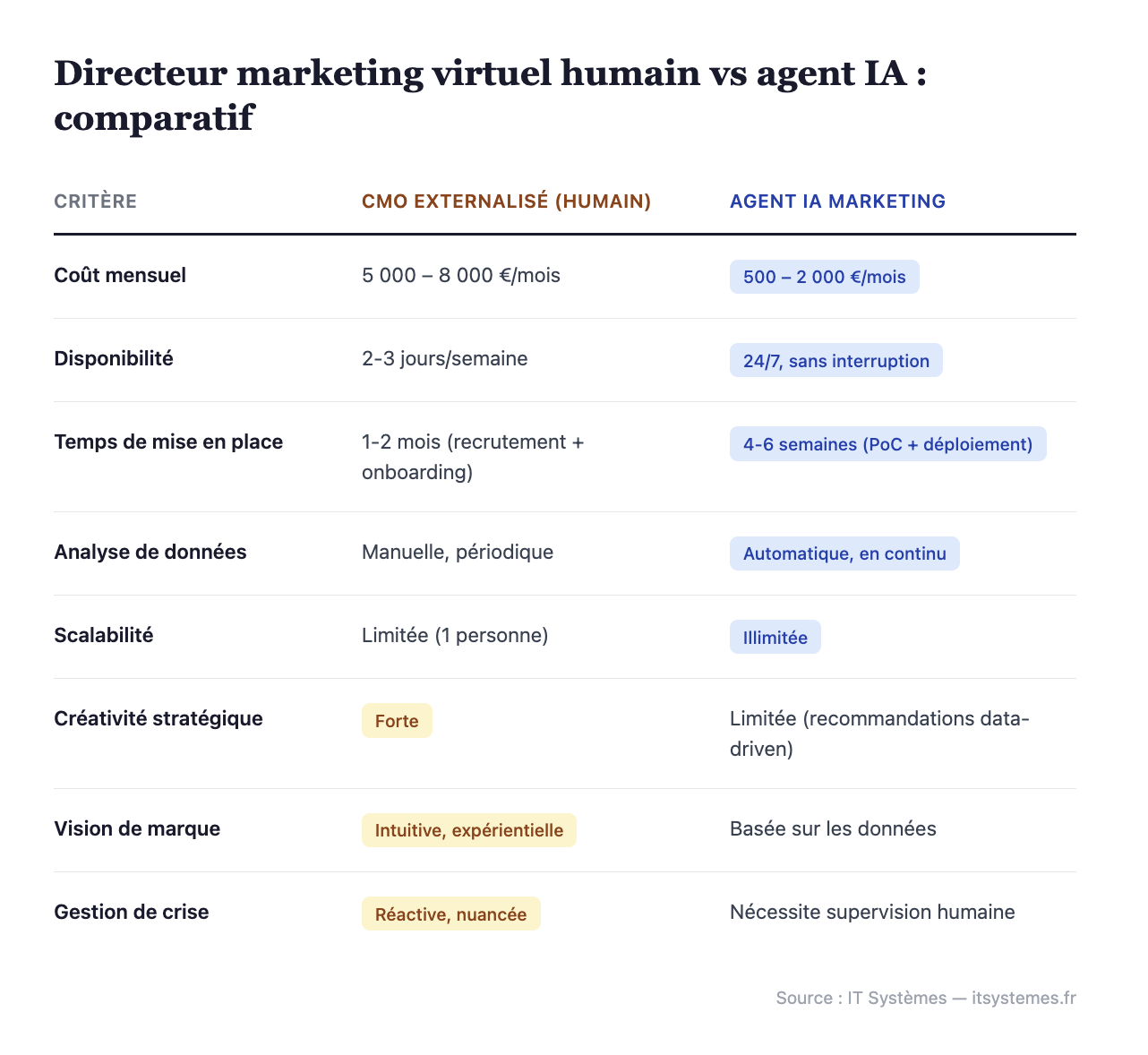
The table clearly shows that it is not a question of choosing one or the other, but of combining the two. The AI agent takes care of analysis, execution, and reporting—all at a controlled cost compared to a traditional AI agent project. Humans focus on strategic vision, creativity, and high-stakes decisions.
How to deploy a virtual AI marketing director in your company
Step 1: Audit your current marketing processes
Before deploying an AI marketing agent, it is essential to map out your existing processes: what tools do you use (CRM, emailing, analytics, CMS)? Which tasks are the most time-consuming? Where are you losing the most value? This audit helps identify quick wins—the first processes to automate for immediate impact.
Step 2: Integrate the agent into your tool ecosystem
The AI agent must connect to your existing marketing stack. The question of integration into your information system is key: our technical guide details how to integrate an AI agent into an existing IS via secure REST APIs, native connectors, or middleware for legacy systems.
For a marketing agent, the most common integrations involve: HubSpot or Salesforce (CRM), Google Analytics and Search Console, Mailchimp or Brevo (emailing), Meta Ads and Google Ads, WordPress or your CMS, and your BI tools.
Step 3: Secure marketing data
Marketing data is sensitive: customer files, behavioral data, purchase histories, segmentation information. GDPR compliance is non-negotiable. We detail best practices in our article on how to secure an AI agent project in a business, which covers encryption, access management, regulatory compliance, and security audits.
Step 4: Roll out gradually and measure ROI
As with any AI agent project, we recommend a gradual rollout: start with a specific use case (e.g., lead qualification or automated reporting), measure the results, then expand. Our 4-6 week PoC methodology allows you to validate the value before investing further. To accurately estimate the return on investment, see our dedicated article: What ROI can you expect from an AI agent project?
The limitations of a virtual AI marketing director (and how to compensate for them)
Un agent IA marketing n'est pas omnipotent. Voici ce qu'il ne fait pas, ou pas encore, de manière autonome :
La créativité pure. Un agent IA peut proposer des variations de messages, analyser ce qui fonctionne et optimiser. Mais l'idée de campagne disruptive, le positionnement de marque, le storytelling émotionnel, c'est encore le terrain de l'humain.
Crisis management. Negative buzz on social media requires judgment, nuance, and empathy. The agent can detect the crisis (spike in negative mentions), alert the right people, and suggest responses, but the final decision must remain human.
Interpersonal relationships. Negotiating with a media partner, convincing an influencer, presenting the strategy to the executive committee—these human interactions remain out of reach.
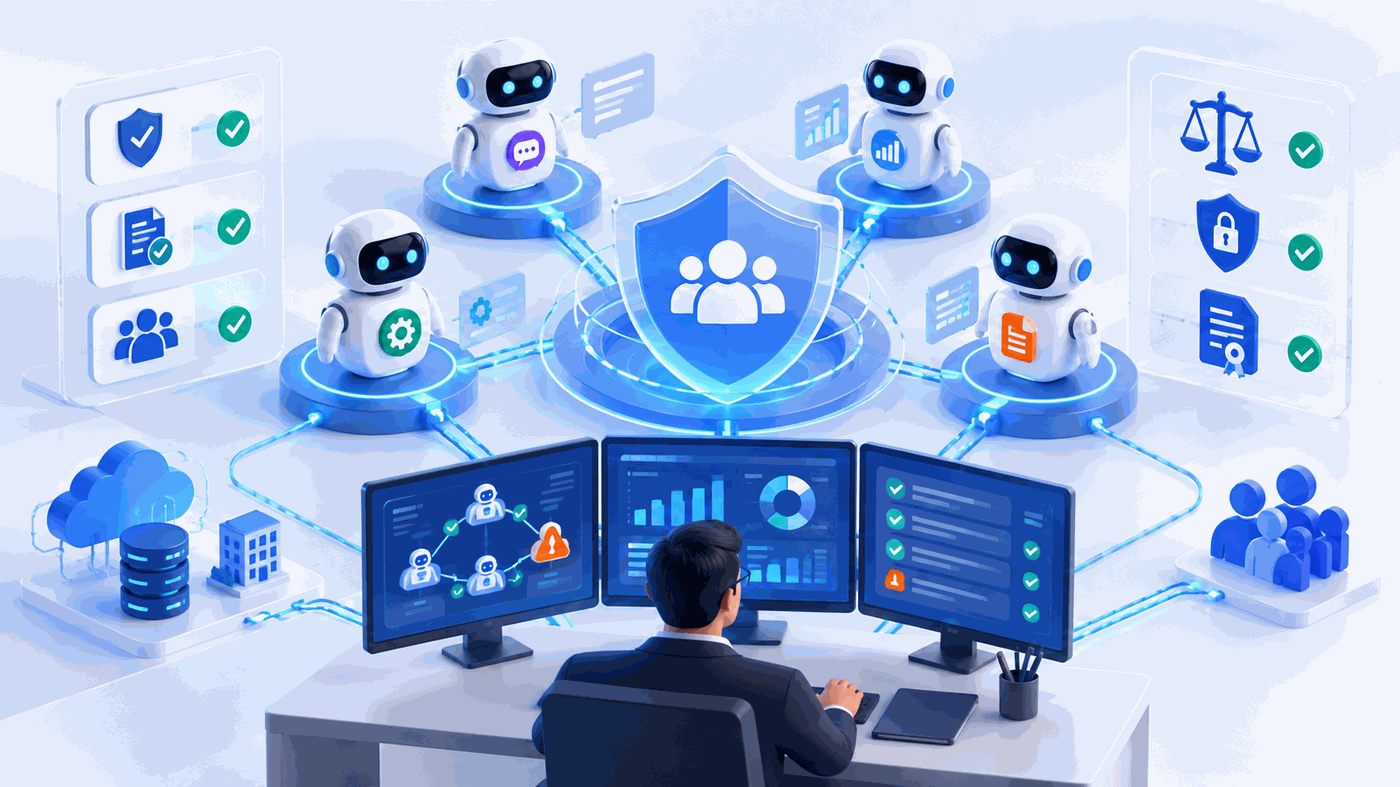
La bonne approche est celle du modèle hybride : l'agent IA gère 70 à 80 % de l'opérationnel marketing (analyse, exécution, reporting), un directeur marketing humain, supervise la stratégie et gère les exceptions. Ce modèle hybride coûte 2 à 3 fois moins cher qu'un recrutement classique, tout en étant plus performant sur l'exécution.
For which companies is the AI virtual marketing director suitable?
The AI virtual marketing director is particularly relevant for:
SMEs with 20 to 200 employees that cannot afford to hire a full-time marketing director but need to structure their strategy. The AI agent takes care of operations, and a senior consultant provides ad hoc support for strategic decisions. To get you started quickly, our AI automation agency offers comprehensive support: from a free audit to deployment, with ongoing monitoring.
Growing mid-sized companies that generate a lot of marketing data but are unable to leverage it. The AI agent transforms this data into concrete, measurable actions.
B2B startups that need to generate qualified leads quickly with a limited budget. The AI agent automates the acquisition funnel and continuously optimizes each step.
Multisite companies that need to adapt their local communications while maintaining brand consistency. The AI agent personalizes messages by geographic area while adhering to the global brand guidelines.
How much does an AI virtual marketing director cost?
The cost depends on the scope of the agent and the complexity of the integrations. For a standard marketing agent (reporting + lead qualification + campaign management), expect to pay between €500 and €2,000 per month during the run phase, after an initial investment in development and integration.
For an accurate estimate tailored to your situation, our article How much will an AI agent cost in 2026? details the different price ranges depending on the type of project.
By way of comparison: an outsourced human marketing director working three days a week costs around €6,000 per month. Hiring someone on a permanent contract costs €8,000–10,000 per month, including social security contributions. The AI agent, even with occasional human support, remains three to five times cheaper.
Conclusion: the virtual marketing director, the first step toward AI-augmented business
The virtual marketing director is not a gimmick. It is a concrete response to a problem faced by thousands of SMEs and mid-cap companies in France: how to have a structured and effective marketing strategy without the budget of a large corporation?
La combinaison agent IA + supervision humaine offre le meilleur des deux mondes : la puissance d'analyse et d'exécution de l'IA, le jugement stratégique et la créativité de l'humain. Et le marketing n'est qu'un début, les mêmes principes s'appliquent à la finance, aux RH, au juridique et à tous les départements de l'entreprise.
IT Systèmes has been helping companies design and deploycustomized AI agents for several years. If you would like to explore what an AI virtual marketing director could do for your business, contact us for a free audit.



.svg)