.svg)
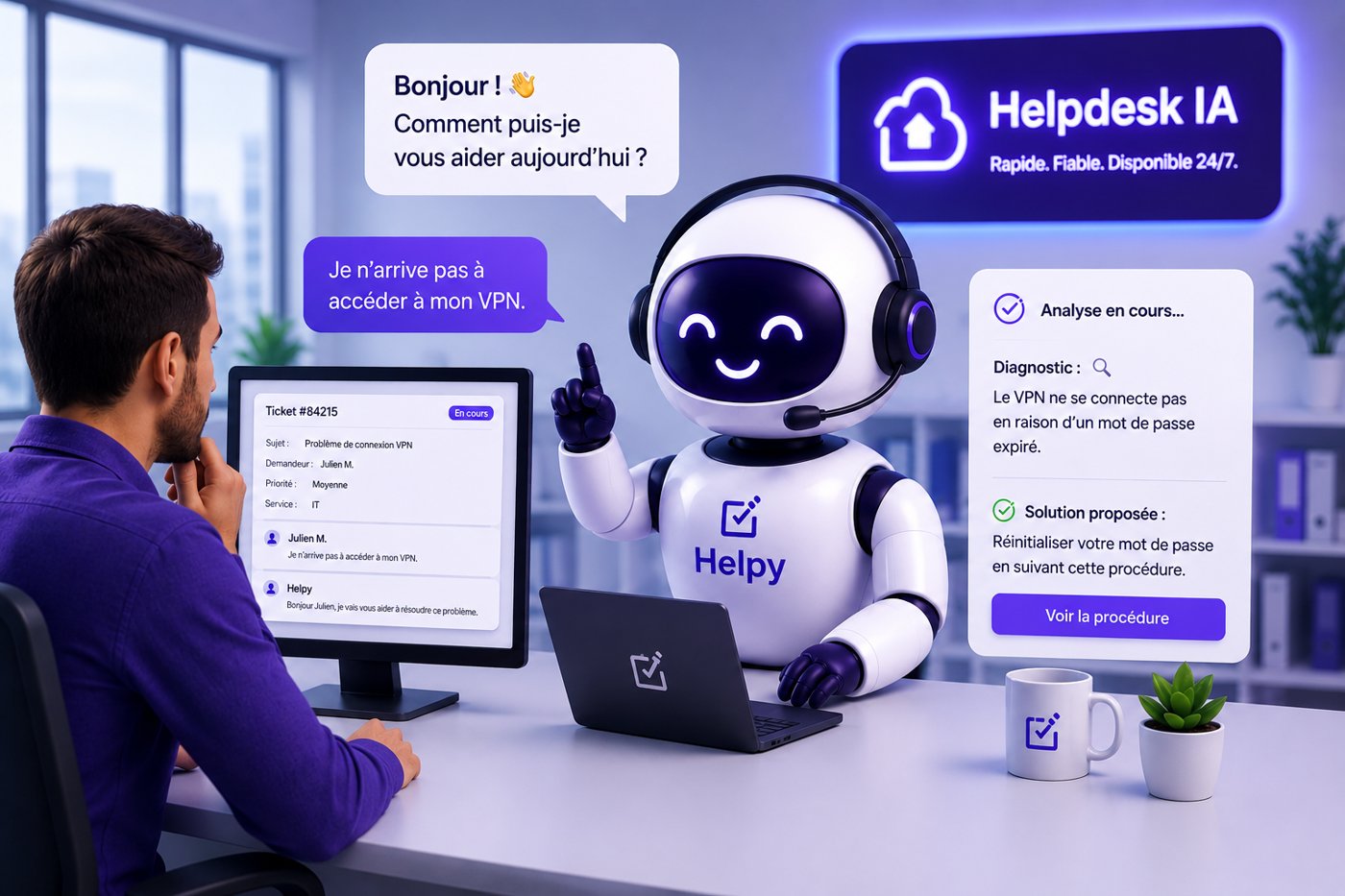
The term “helpdesk” encompasses three things that are often confused: a function (support), a profession (the technician), and a tool (the software). At IT Systèmes, we’ve been providing managed IT services since 2010: we manage helpdesks every day for dozens of organizations. This guide is based on that experience. It clarifies the three meanings of the term, explains what a helpdesk is really for, reviews the different types of solutions, and helps you choose the one that fits your situation, from traditional ticketing software to AI-enhanced support.
What is a help desk?
A helpdesk is the single point of contact between users and support, responsible for receiving, organizing, and resolving their requests. In French, it is referred to as a "centre d'assistance" or "service d'assistance."
In practice, when an employee can no longer connect to the VPN, a customer reports a bug, or a user has forgotten their password, the helpdesk receives the request, assesses it, and either handles it or directs it to the appropriate person. Each request becomes a “ticket” that is tracked until it is resolved.
The term refers both to the function (the team and its organization) and to the software that supports it. It is this dual meaning that causes confusion.
Internal help desk or external help desk?
There are two main groups, and they face different challenges.
The internal helpdesk (or IT helpdesk) handles requests from company employees regarding issues with workstations, access, email, and business applications. It provides day-to-day IT support.
The external helpdesk handles customer inquiries: questions about a product, complaints, and order tracking. This is generally referred to as customer support or after-sales service.
Both share the same core features (tickets, knowledge base, escalation), but are designed for different audiences and serve different purposes. This guide focuses primarily on internal IT helpdesks, although most of the information applies to both.
Check out our help desk solution ->
What is the role of a help desk?
The role of a help desk goes far beyond simply "answering questions." It serves four functions.
Centralize. All requests come to one place, regardless of the channel (email, phone, chat, form). No more scattered requests that get overlooked.
Traceability. Every request is logged, tracked, and archived. We know who requested what, when, and what was done. This traceability is essential for measuring support quality and meeting service commitments.
Prioritize. Not all requests are equal. A downed production server takes precedence over a request to install software. The help desk categorizes and prioritizes requests.
Build on past experience. Resolved issues contribute to a knowledge base. The same issues aren't re-diagnosed from scratch every time.
Support levels: N1, N2, N3
A help desk is typically organized into tiers.
Level 1 (L1) handles simple, common requests: password resets, login issues, and general usage questions. This accounts for the largest volume—often 60 to 70% of tickets—and is the least complex.
Level 2 (L2) handles incidents that require diagnosis: abnormal application behavior, network issues, or specific configuration problems.
Level 3 (N3) involves specialized expertise: infrastructure work, critical issues, and project support.
This tiered structure has a direct consequence, which we can see in our own operations: the majority of a help desk’s workload is concentrated on repetitive Level 1 support—precisely the part that is most amenable to automation. In our managed services operations, Level 1 support accounts for the bulk of ticket volume. We’ll come back to this later.
What is a help desk technician?
A help desk technician is the person who handles support tickets, typically at levels 1 and 2. Their job involves receiving requests, diagnosing issues, resolving or escalating them, and documenting the process. This is often an entry-level position in the IT field, requiring both technical skills (systems, networks, applications) and interpersonal skills (the ability to explain things clearly, patience, and clarity).
As we saw earlier, much of this work is repetitive. This is where the field is evolving the fastest. With the introduction of AI in support, the most routine tasks—such as forgotten passwords and general usage questions—are being automated, allowing technicians to refocus on troubleshooting, complex cases, and providing guidance. In our experience, this isn’t a threat to the job but rather an increase in value: it’s easier to retain a technician who is entrusted with interesting tasks than one who spends their day resetting passwords.
Types of help desk solutions
When you're looking for a help desk solution, you'll come across a wide variety of tools. Here's how to tell them apart.
Traditional ticketing software
This is the traditional solution: a tool that creates, organizes, and tracks tickets. The user submits a request, which becomes a ticket; a technician takes it on, resolves it, and closes it. Tools like GLPI (open source, widely used in French IT departments), Zendesk, or Freshdesk handle traceability, queues, and service level agreements very well. GLPI is, in fact, often the foundation we find at our clients’ sites.
Their limitation: they organize the work, but don’t do it themselves. The technician remains in charge of each resolution. A forgotten password ticket and a server incident follow the same path: they wait for a human to handle them.
The help desk solution with a knowledge base
A shift in ticketing: we’re adding a knowledge base (FAQs, articles, procedures) that allows users to find the answer themselves before opening a ticket. In theory, this reduces the volume of tickets. In practice, it doesn’t work well: the knowledge base needs to be kept up to date, and, more importantly, users need to take the time to search before asking. Most don’t. This is something we see all the time in the field.
The AI-powered helpdesk solution
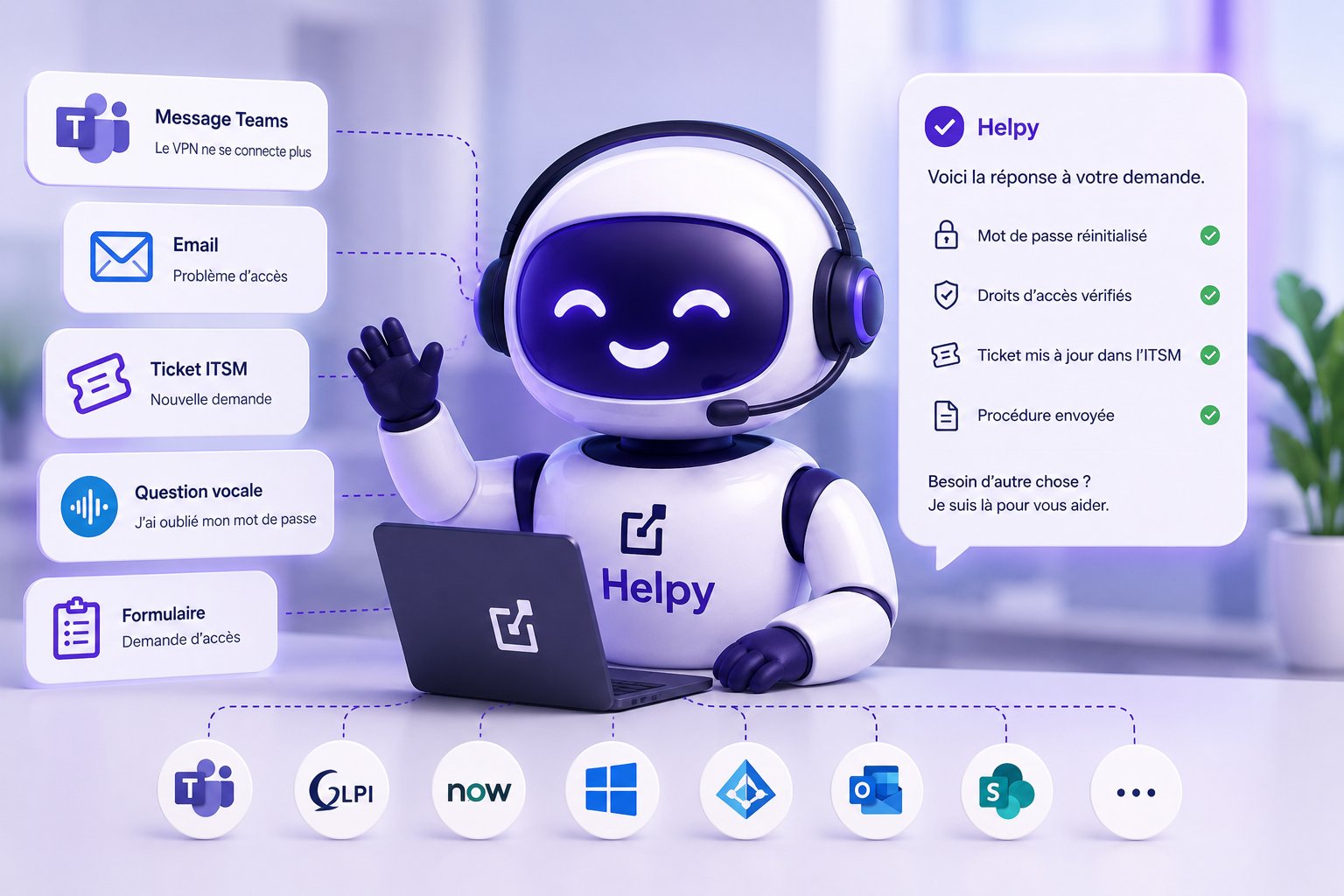
This is the latest generation. AI no longer simply suggests an article; it understands the request, retrieves the answer from the database, and provides it directly to the user. The best solutions go a step further and perform the action: resetting a password, unlocking an account, or automatically opening or closing a ticket.
This is the key difference between traditional helpdesk software and an AI-powered helpdesk: the former organizes, while the latter resolves issues. But be careful—many solutions labeled “AI” are actually limited to a chatbot that answers questions without taking any action. The real value lies in action, not in conversation.
Why AI Is a Game-Changer for Help Desks
The initial observation is always the same, and we see it with nearly all the clients whose IT outsourcing we take over: the majority of help desk tickets are repetitive. Forgotten passwords, VPN access, email synchronization, permissions to be granted. These are requests that a technician handles ten times a day, and they place a heavy burden on the first-line support team.
Here’s the point we’re making—and it can be a bit of a hard sell: paying qualified technicians to reset passwords all day long is a waste. Not just a waste of money, but a waste of skill and motivation. Good technicians don’t stick around long in a job where they do the same thing over and over again.
An AI-powered help desk specifically addresses this volume. It autonomously handles recurring requests 24 hours a day in just a few seconds, leaving technicians to focus on cases that truly require their expertise. In our own IT outsourcing operations, Helpy resolves 44% of Level 1 tickets autonomously (average measured from April 2025 to February 2026), with response times dropping from several hours to just a few minutes.
The key is to choose a solution that actually works —not just a chatbot that redirects users to an FAQ. That’s what separates a gimmick from a tool that transforms day-to-day support operations.
Our experience: We built our own AI-powered helpdesk solution, Helpy, and we’re using it for our internal IT support before offering it to our clients. Learn more about Helpy or read the full case study.
How to Choose a Help Desk Solution
The right choice depends on your situation. Here are some questions to ask yourself.
What is your volume of tickets, and what percentage of them are repetitive? If you handle few requests and they are varied, standard ticketing software will suffice. If you’re overwhelmed by repetitive requests, an AI-powered solution will make all the difference.
Internal or external helpdesk? Solutions designed for customer support (after-sales service) are different from those designed for internal IT support. Make sure the tool meets your actual needs.
How well does it integrate with your tools? A help desk solution is only valuable if it’s connected to your environment: your email system, your directory (Active Directory), and your business tools. A standalone solution leads to duplicate data entry.
What are the security and compliance requirements? Data hosting, GDPR and AI Act compliance, and access tracking: these criteria are critical in regulated industries.
What is the actual level of autonomy? Be wary of “AI” solutions that are nothing more than a fancy FAQ. Ask what the tool can do on its own: respond, yes, but also take action (reset, unlock, escalate with context)?
Do you retain ownership? With custom solutions, make sure to verify who owns the knowledge base, the configuration, and the data. Reversibility prevents vendor lock-in.
The right helpdesk depends on your situation
There is no single "best" helpdesk solution. For a small business with few tickets, a simple ticketing system will do the job. For an organization that handles a high volume of repetitive IT support requests, an AI-powered solution saves a considerable amount of time and improves the user experience.
The deciding factor is usually not the cost of the license, but the number of repetitive tasks you can take off your teams’ shoulders. That’s where the true return on investment comes into play.
Frequently Asked Questions About the Helpdesk
What is a help desk?
A helpdesk is the single point of contact responsible for receiving, organizing, and resolving user support requests. The term refers to both the function (the support team) and the software that powers it. There are two main types: the internal helpdesk (IT support for employees) and the external helpdesk (customer support).
What is the role of a help desk?
Centralize requests, track them, prioritize them, and document solutions in a knowledge base. A help desk ensures that no request is lost and that recurring issues aren’t re-diagnosed every time.
What is the difference between traditional helpdesk software and an AI solution?
Traditional helpdesk software organizes and tracks tickets, but resolution is still a manual process. An AI-powered helpdesk solution understands the request, formulates the response, and performs the action (resetting a password, unlocking an account) on its own. The former organizes the work, while the latter carries out part of it.
What is an IT help desk?
An IT help desk is an internal support service dedicated to helping company employees resolve technical issues related to their workstations, access, email, and applications. It differs from external customer support in terms of its target audience (employees) and the issues it addresses (the digital work environment).
How much does a help desk solution cost?
It depends on the type. Ticketing software is often billed per agent per month. An AI-powered helpdesk solution is billed based on scope and volume. Our Helpy solution, for example, is offered at €9 per user per month, all-inclusive.
Does an AI-powered helpdesk replace technicians?
No. It handles the repetitive, well-documented portion of support tickets (Level 1), which frees up technicians to focus on complex incidents, projects, and security. For sensitive actions, human approval is still required. The role of a technician is evolving toward providing greater value—it is not going away.
Learn more
If you want to automate the repetitive aspects of your IT support, check out Helpy, our AI-powered help desk solution : It resolves 40% to 60% of Level 1 tickets on its own, integrates with your ITSM, and is hosted in France.
To understand how to categorize an AI project (simple tool, business agent, or major transformation), read our guide: AI Tools, AI Agents, and Strategic AI Projects: Choosing the Right Level.
See also our case studies: How we automated 44% of Level 1 tickets independently (average measured from April 2025 to February 2026) using an AI agent
Schedule a help desk audit (30 min, free)
.jpeg)


.jpeg)



.svg)