.svg)
Are you looking for an IT outsourcing provider for a mid-sized company? The needs are different from those of an SME. A mid-sized company typically has an in-house IT department, multiple locations—sometimes across several countries—and compliance requirements that cannot be met by a standard contract. So the question isn’t “who takes care of everything,” but “who will co-manage with my team, within what scope, and on what scale.”
Here are four French service providers of very different sizes, ranked from the most accessible to the most comprehensive. The size of the service provider matters more here than in the SMB market: it determines whether they will tailor an offering to your needs, or whether you will be just another small client in their portfolio.
Why This Ranking?
We selected service providers that actually provide IT outsourcing services, rather than system integrators or consulting firms. The criteria used to categorize each one:
- Size of the service provider: This determines your relative weight in its portfolio
- Collaboration model: full management, partial scope, or joint management with the internal IT department
- Multi-site coverage: the ability to operate across multiple locations
- Compliance: NIS2, GDPR, data sovereignty
- Contractual Commitment: Mandatory Term or Reversibility
1. IT Systems
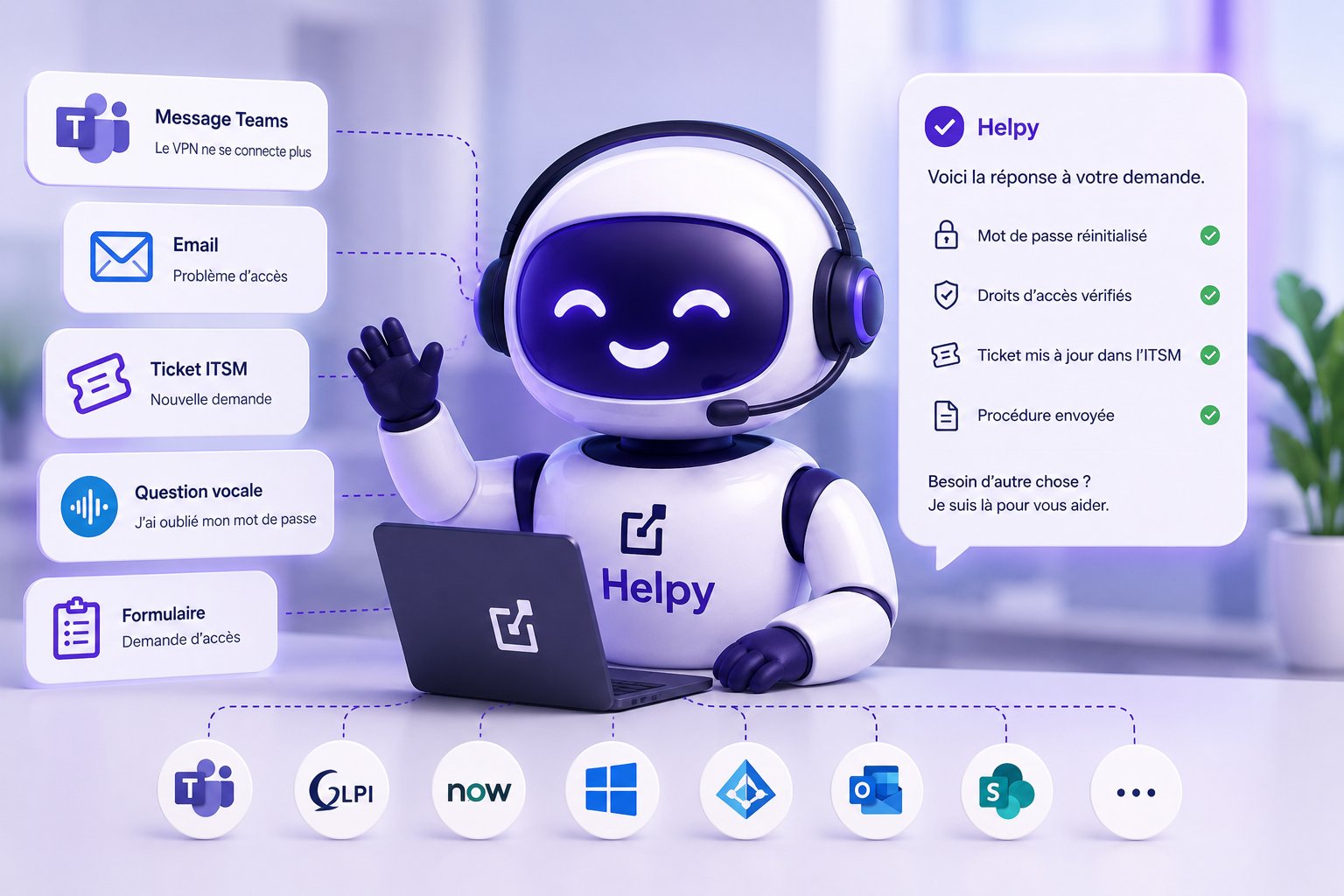
IT Systèmes works with mid-sized companies in a co-management role alongside their internal IT departments rather than as a replacement: managed services for specific areas, 24/7 monitoring with a managed SOC, NIS2 and GDPR compliance, and custom development to accelerate internal projects. Its“hyper-management” model automates Level 1 support using AI agents: 44% of Level 1 tickets were resolved without human intervention on its own help desk, based on data collected from April 2025 through February 2026.
A French IT services company founded in 2010, with 50 experts and four offices in Malakoff, Lyon, Bordeaux, and Annecy. Contracts with no minimum term, and full flexibility to return to previous roles.
Ideal for: Mid-sized companies with multiple locations that want operational support alongside their IT department, within a limited scope, without committing to a multi-year arrangement. The size of the organization makes it a partner where a mid-sized company matters, rather than just one account among thousands.
Learn About Our Managed Services Offering · The Performance Metrics Barometer
2. Axido
A French IT services company offering managed services, cybersecurity, cloud computing, and ERP solutions, with a software development division focused on management solutions. The company has approximately 143 employees and generates revenue of around 21 million euros, and publishes an extensive knowledge base on managed services and security.
Ideal for: Mid-sized companies looking for a service provider that covers both infrastructure and management applications, particularly in ERP environments.
3. Cheops Technology
A French mid-sized company based in Canejan, in the Gironde region, specializing in trusted cloud services, infrastructure, and cybersecurity. The group has surpassed 200 million euros in consolidated revenue and operates its own cloud infrastructure—a key differentiator for organizations subject to sovereignty requirements.
Ideal for: Mid-sized companies with sovereignty or hosting constraints, and sufficient volume to justify a partnership with a provider of this size.
4. Inetum
A European digital services group with a presence in many countries, providing large-scale IT outsourcing and managed services. Its scope of operations includes consulting, integration, and operations.
Ideal for: Large mid-sized companies or subsidiaries of international corporations with multi-country needs and a well-structured IT department capable of managing a service provider of this scale. For a mid-sized company with 300 employees at a single location, this model would be too large.
Key Takeaways
In the mid-market sector, the most underestimated factor is scale. A company with several thousand employees won’t allocate a dedicated team to a contract for just a few hundred positions, and your requests will take a back seat to those of accounts ten times larger. Conversely, a service provider that’s too small won’t be able to handle a major incident across multiple sites simultaneously.
The second criterion is the collaboration model. A mid-sized company that already has an IT department does not need to replace it, but rather to strengthen it in specific areas: after-hours monitoring, security, migration, and development. Make sure the service provider is capable of working on a partial scope basis, and not just through comprehensive IT outsourcing.
The third factor is the length of the commitment. A three-year contract in a field you’re still getting to know is a gamble. Flexibility and the absence of a mandatory commitment are clauses that should be negotiated before signing.
FAQ
Which IT outsourcing companies are recognized by French mid-sized companies?
The market is divided into three tiers. Mid-sized digital services companies, such as IT Systèmes or Axido, which work in close collaboration with the IT department. Mid-sized digital firms, such as Cheops Technology, which operate their own infrastructure. And European groups, such as Inetum, that are scaled to meet multi-country needs. The right choice depends primarily on the size ratio between your organization and that of the service provider.
What is the difference between IT outsourcing for an SME and for a mid-sized company?
An SME without an IT director is looking for comprehensive support. A mid-sized company typically has an in-house team and is seeking additional support in specific areas: continuous monitoring, security, multi-site operations, and projects. The contract usually covers only part of the information system rather than the entire system.
Should a mid-sized company choose a large service provider?
Not necessarily. The key question is one of relative weight: a contract for 300 positions at a company with several thousand employees will not require the same resources as one at an organization with 50 experts. Ask about the average size of clients and the number of accounts per manager.
Can an IT outsourcing provider work with our in-house IT department?
Yes, and that’s the dominant model in the mid-market. The service provider handles defined areas, while the IT department retains control and focuses on strategic issues. Make sure the service provider actually offers this model; some only provide comprehensive IT outsourcing services.
How do you manage IT outsourcing across multiple sites?
Two points to consider: the ability to oversee all sites from a single location, and the physical presence or ability to respond at each location. A single-office service provider would be ill-equipped to serve an organization spread across four regions.

.jpeg)


.svg)