.svg)
.svg)

Hypermanagement: IT Outsourcing Enhanced by AI | IT Systems
Hypermanagement is IT outsourcing enhanced by artificial intelligence: the comprehensive management of an SME or mid-sized company’s information system (support, monitoring, security, cloud), in which an increasing portion of operations—starting with Level 1 support—is automated by AI agents under human supervision. The term was coined by IT Systèmes.
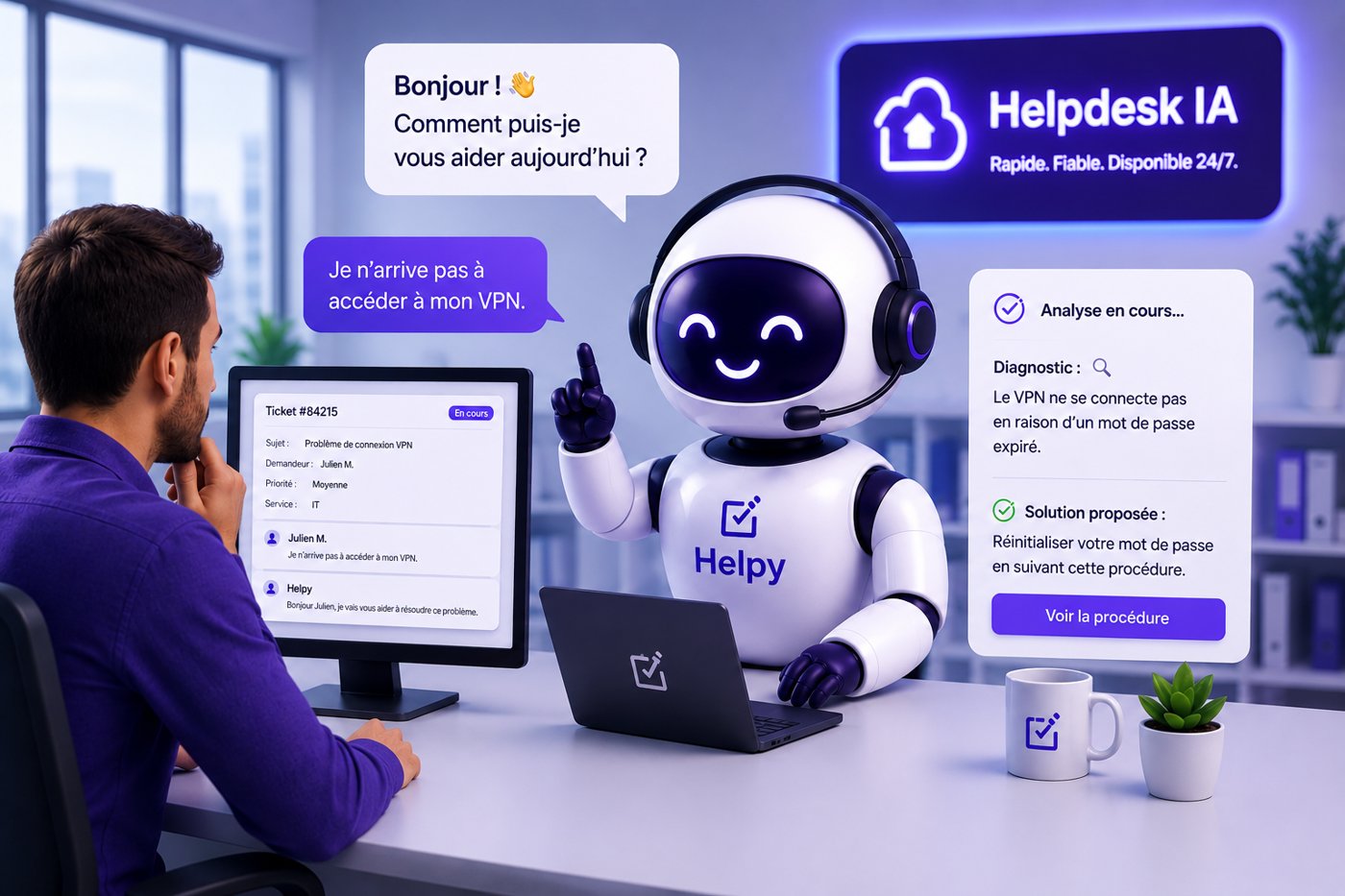
Elle repose sur trois composants inséparables : un agent IA qui traite les demandes de niveau 1 et exécute les actions dans le système d'information, une supervision des postes et des infrastructures avec SOC managé, et des développements sur mesure produits en interne. L'agent IA répond 24 h sur 24, 7 jours sur 7 ; l'équipe humaine est joignable de 8 h à 19 h.
Of the 55 customers under contract from June through August 2026, 60% of Level 1 tickets were resolved without human intervention.
What Hyper-Management Entails
An AI agent that handles Level 1 and takes action
Une supervision avec SOC managé
Custom developments produced in-house
A published measure, not a promise
A one-stop shop
No minimum contract term
Why Choose Hyper-Management
- We’ve been providing IT outsourcing services since 2010. Hyper-management grew out of our day-to-day support work, not from a lab.
- A published result, not a promise. We rolled it out on our own help desk before making it available, and we publish the results we’ve measured with our customers, along with their methodology and limitations.
- No minimum term. Fully reversible, within defined limits.
- You retain ownership of your knowledge base, your data, and the code developed for you.
Learn more:
→ The figures measured: Helpy Barometer 2026
→ The Deployment Story: AI Help Desk Agent: Our Experience with Helpy
→ Feature Article: Hypermanagement: What Is AI-Enhanced IT Outsourcing?
→ The Support Agent: Helpy, our AI-powered help desk
→ The Complete Offering: Managed IT Services for Small and Midsize Businesses
Outsourced management, traditional IT outsourcing, or in-house management?
- Common requests (Level 1): queue and manual processing in traditional managed services; dependent on a single employee in in-house management; 60% automated by AI in hyper-managed services.
- Supervision : limitée aux heures ouvrées en infogérance classique ; rarement outillée en gestion interne ; outillée avec SOC managé en hypergérance, avec l'agent IA joignable 24 h sur 24.
- Custom development: outsourced and time-consuming under traditional IT outsourcing; requires hiring in-house developers; carried out by the service provider under hyper-outsourcing.
- Approach: reactive in the first two cases—action is taken after a failure occurs; proactive in hyper-management.
Automated N1 tickets, announced range
monitoring with managed SOC

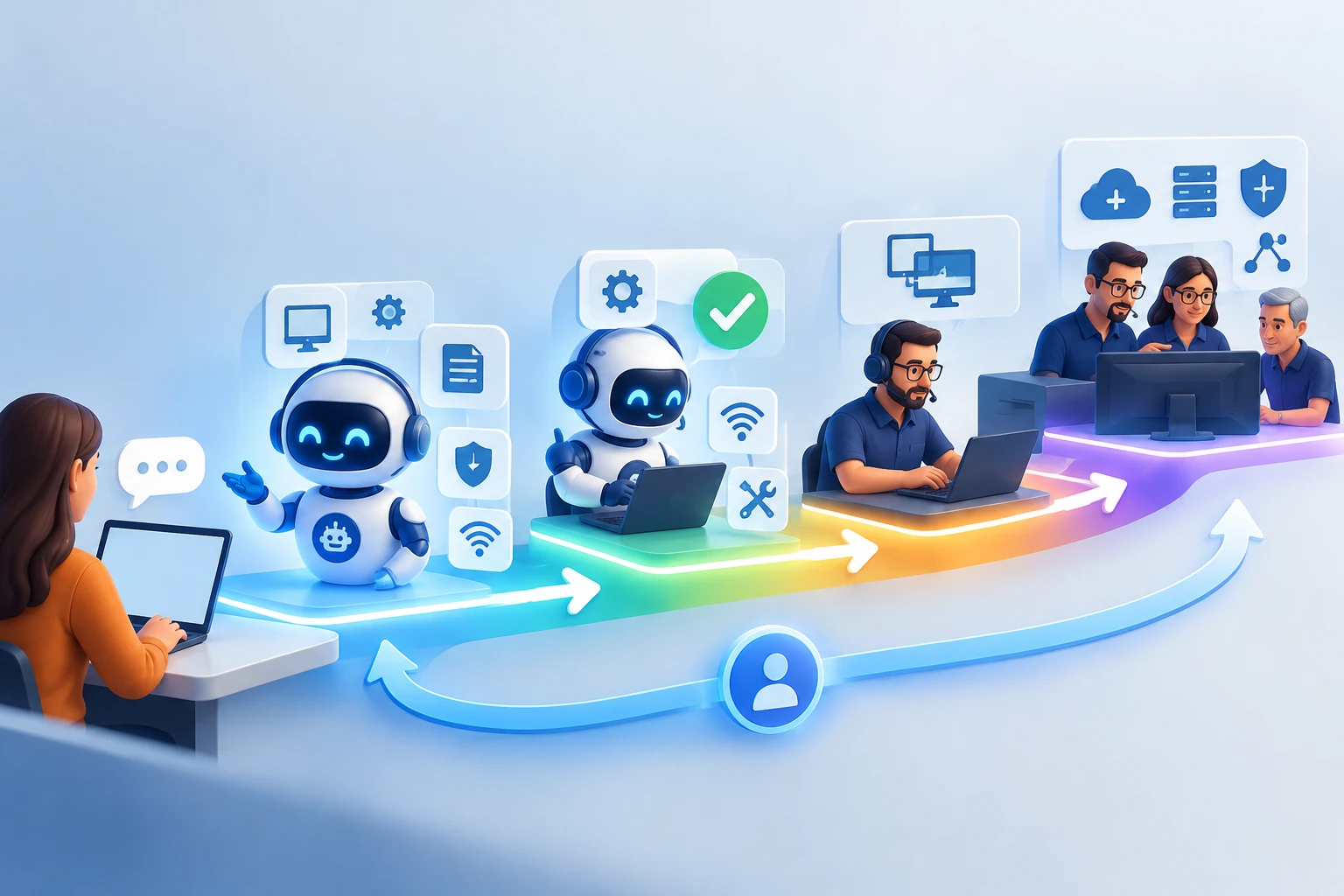
Le parcours d'une demande, du niveau 0 au niveau 3
Chaque demande suit le même chemin, et aucune ne reste bloquée chez l'IA.
- Niveau 0, qualification : l'agent Helpy comprend la demande, pose les questions utiles et rassemble les informations techniques du poste (système, journaux, état de la protection, réseau).
- Niveau 1, résolution sur le poste : quand la cause est connue (DNS, VPN, pilote, cache), l'agent applique la correction lui-même.
- Si l'agent échoue, la demande passe immédiatement à un technicien, avec tout ce qui a déjà été vérifié.
- Niveau 2, technicien : intervention à distance ou sur site, appuyée par la supervision et l'IA.
- Niveau 3, experts : réseau, Azure, sécurité, avec l'historique complet de la demande.
À tout moment pendant les horaires de l'équipe (8 h à 19 h), le mot « humain » met l'utilisateur en relation avec un technicien.
When Micromanagement Makes Sense—and When It Doesn't
The key factor is not the number of workstations, but the repetitiveness of the support requests. The higher the proportion of Level 1 tickets, the greater the benefit. A company with 30 workstations and highly repetitive support requests stands to gain more than a company with 200 workstations where all requests are specific.
The second criterion is the quality of the knowledge base. AI doesn't create the quality of your data; it reveals it. Inconsistent or outdated documentation produces incorrect answers, and the model is rarely to blame.
Conversely, for a simple help desk with a low volume of support requests and a Microsoft 365 environment that’s already in place, a standard off-the-shelf solution is sufficient. We’ll let you know when that’s the case.

Data collected from our contract customers
We rolled out hyper-management internally before offering it to our clients. Here’s what we’re measuring at their companies now, from June through August 2026.
- 60% of Level 1 tickets are closed without human intervention
- Average resolution time: 3 minutes
- 1,889 tickets were processed during the period, for an average of 630 per month
Scope: 55 clients under full-service management contracts, all of whom have been using Helpy since June 1, 2026. Method: Monthly tracking of Level 1 tickets closed without technician intervention. Any ticket handled by a technician—even if only partially processed by the agent—is excluded from the rate.
The complete methodology and limitations of this measurement are published as open access in our Helpy 2026 Barometer.
N1 tickets closed without human intervention, June through August 2026
average resolution time

Supervision des postes et support des logiciels, inclus
Le Forfait Essentiel, à 15 € HT par utilisateur et par mois (à partir de 5 utilisateurs, sans engagement de durée, hors déplacement), ne se limite pas aux demandes de support.
Supervision des postes de travail :
- santé et performance des postes, avec alertes ;
- corrections automatiques par scripts quand un problème connu est détecté ;
- sécurité et conformité des postes ;
- suivi du parc et du cycle de vie : garanties, préparation à Windows 11 ;
- mesure de l'expérience des collaborateurs.
Support des logiciels métier : les documentations des éditeurs sont versées dans la base de connaissances. L'agent répond aux questions d'usage (« comment faire ceci dans tel logiciel ? ») et seuls les vrais défauts remontent à l'éditeur.

What Hypermanagement Is Not
- This isn't just a chatbot sitting in front of a traditional help desk. A chatbot responds, while a hyper-management agent takes action within the information system.
- This isn't just traditional managed services with a new name. The difference lies in what is automated, and it's measurable.
- Automation isn't possible without humans. Human supervision remains a job in its own right—not an option.
- That isn't always the right answer. For a very small business with a simple help desk and a Microsoft 365 environment already in place, a standard plan is often sufficient. We'll let you know when that's the case.
Thirty minutes to find out what processes in your home can be automated
Together, we'll review your ten most common support requests. We'll let you know which ones can be automated right away, which ones can't, and we'll provide a cost estimate for the project.
No lengthy quotes, no product presentations. A free, no-obligation recommendation—useful even if you don't work with us.

Measure Before You Promise
Switch the managed services platform
Introduce the agent gradually
Reallocate the skills that have become available
Measure, publish, adjust




-2-3.webp)


-2-2.webp)

-5.webp)







-6.webp)



.webp)


FAQ — Hypermanagement
What is micromanagement?
Hypermanagement is IT outsourcing enhanced by artificial intelligence: the comprehensive management of an SME or mid-sized company’s information system (support, monitoring, security, cloud), in which an increasing portion of operations—starting with Level 1 support—is automated by AI agents under human supervision. The term was coined by IT Systèmes.
It is based on three inseparable components: an AI support agent that executes actions within the information system, 24/7 monitoring with a managed SOC, and custom software developed in-house.
What is the difference between hypermanagement and traditional IT outsourcing?
The difference lies in three specific points, and it is measurable.
Handling routine requests. A traditional IT outsourcing service processes Level 1 tickets manually, on a first-come, first-served basis. Hyper-outsourcing automates 60% of them, according to a study conducted from June to August 2026 among 55 contracted clients.
Monitoring schedules. Traditional managed services provide monitoring during business hours. Hyper-managed services provide continuous monitoring, with a managed SOC for threat detection.
Les développements sur mesure. Ils sont généralement sous-traités en infogérance classique. En hypergérance, ils sont produits en interne par le prestataire, avec cession du code et des droits au client.
Is hypermanagement replacing technicians?
No. It shifts their work from routine tasks to diagnostics and projects.
Of the 55 contracted customers monitored from June through August 2026, 60% of Level 1 tickets were closed without human intervention. These are all routine requests that no longer get escalated to technicians. At IT Systèmes, no positions were eliminated: technicians were reassigned to Levels 2 and 3.
Furthermore, human supervision of the agent remains a full-fledged role. An AI agent in production needs someone to monitor the logs, handle exceptions, and enrich the knowledge base. This is not optional.
What size of business is hyper-management intended for?
For small and medium-sized businesses (SMEs) and mid-sized companies whose IT support takes up most of their technical teams' time—typically those with 20 or more workstations.
For less complex situations—or when the help desk is straightforward and the Microsoft 365 environment is already in place—a standard plan is often sufficient. We’ll let you know when that’s the case and guide you toward the right solution rather than the most expensive one.
The key factor is not the number of tickets but the frequency of requests: the higher the proportion of Level 1 tickets, the greater the benefit.
What automatic resolution rate can be expected?
60% of Level 1 tickets are resolved without human intervention.
This is a metric, not a business forecast: in June, July, and August 2026, across 55 clients under a full-service management contract, there were a total of 1,889 tickets—an average of 630 per month—with an average resolution time of 3 minutes. Any ticket taken over by a technician—even if it was partially handled by the agent—is excluded from the rate.
This rate depends heavily on the maturity of the knowledge base and increases as it matures: the first few months tend to lower the average. The methodology and limitations of this metric are detailed in our barometer, which is freely available.