.svg)
.jpeg)
Integrate AI into your ticketing system to handle some of the Level 1 support
How it actually works, how much it costs, and what the limitations still are in 2026.
Key Takeaways
- An AI help desk doesn't just respond—it takes action by directly resetting a password or unlocking an account, rather than simply suggesting these solutions.
- According to Gartner, a majority of customer service managers feel pressure to implement AI. The firm predicts that a growing proportion of enterprise applications will incorporate a specialized AI agent by the end of the decade.
- At IT Systèmes, the Helpy agent resolves 60% of Level 1 tickets without human intervention (based on data from June through August 2026, across 55 contracted clients) within the company’s own managed services operations, before the tickets are forwarded to clients.
- The main risk is organizational, not technological: a poor knowledge base produces incorrect answers with the same confidence as correct ones.
- A fully functional AI help desk handles documented Level 1 tickets on its own, with human oversight for sensitive cases—a far cry from a basic chatbot linked to an FAQ.
What an AI help desk Actually Does—and What It Doesn't Do
The pressure is coming from two sides. Senior management wants to reduce support costs without compromising the user experience, while Level 1 technicians spend most of their time on repetitive requests (forgotten passwords, VPN access, unlocking permissions) that don’t require human expertise. This is the gap that AI-powered ticket management fills—provided you don’t confuse “the tool exists” with “the tool is ready for your IT system.”
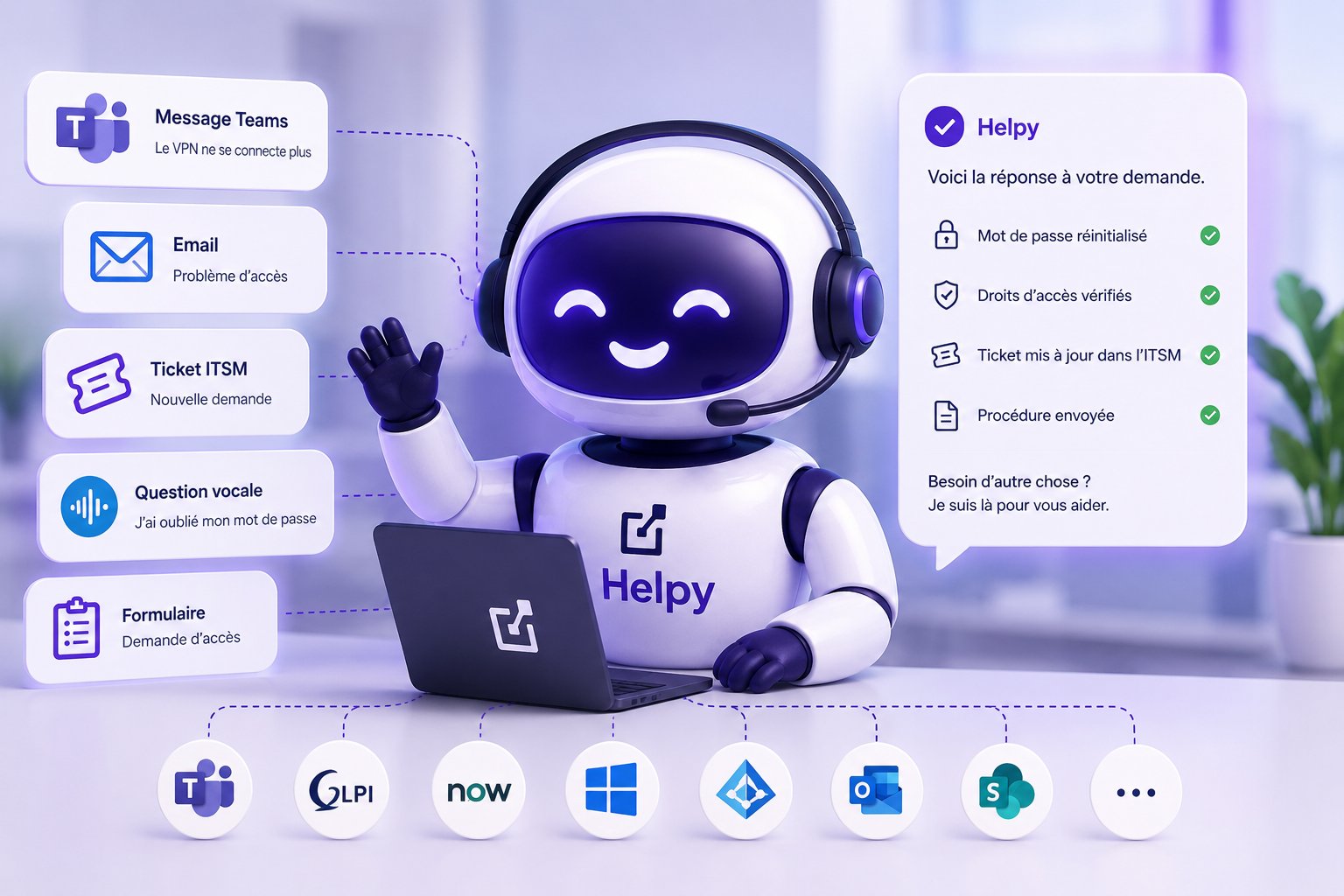
The most common misconception: equating “AI in support” with a chatbot that redirects users to an FAQ. That’s the previous generation. A modern AI help desk agent understands the natural language of the request, queries a vectorized knowledge base (documentation, procedures, history of resolved tickets), and—for simple, well-documented cases—performs the action itself: resetting a password, unblocking an account, or verifying permissions in the directory. For sensitive actions, it makes a recommendation, which a technician then approves.
What AI doesn't do well in 2026: undocumented incidents, situations that require business judgment, and anything involving high-stakes decisions (security, HR, finance) without human validation. An AI support agent handles the repetitive workload so that human expertise can focus on areas where it adds value; it does not replace business judgment.
| Criterion | Traditional Help Desk | Help Desk with an AI Agent |
|---|---|---|
| Processing a recurring ticket | Created, sorted, and then manually resolved by a technician | Resolved independently if the case is documented |
| Availability | Hours worked, plus on-call duty | 24 hours a day, with no marginal cost per ticket |
| Knowledge Base | Checked manually by the technician | Queried automatically with each request |
| Role of the N1 Technician | Handles the volume, including simple cases | Handles exceptions and complex cases |
| Improvement Over Time | Depends on each person's background | Grows as the ticket database expands |
What ticketing tasks can AI handle today?
The level of maturity of an AI help desk is reflected in its ability to take action, not just to respond. Here's how this typically breaks down by support level.
| Level | Type of Request | What Support AI Handles Today |
|---|---|---|
| N1 | Forgotten password, VPN access, locked account, question about an M365 tool | Independent resolution of documented cases; action taken directly |
| N1 / N2 | View or change access rights; create an account | Automatic verification in Active Directory; action proposed and then approved by a technician |
| N2 | Hardware failure, unclassified application malfunction | Assessment of the request and preliminary diagnosis; resolution remains a human task |
| N3 | Infrastructure, Security, and Architecture Incidents |
Outside the scope of AI: systematic escalation to an engineer
|
Key takeaway: Starting with the 10 to 20 most common ticket reasons yields the best initial return on investment. This is also the method used to guide the rollout ofHelpy, IT Systèmes’ AI help desk agent →
One point that is often underestimated: the quality of the responses depends entirely on what the agent knows, not on the sophistication of the model behind it. An AI system connected to incomplete or outdated documentation will provide incorrect answers with the same level of confidence as a correct one. The structure of the knowledge base has a greater impact on the final result than the choice of the underlying AI model.
How much does AI-powered ticket management cost, and what is the return on investment?
The profitability of an AI helpdesk is calculated based on two factors: the direct cost of the solution and the time saved for technicians to focus on higher-value tasks.
| Job | What Is Typically Billed | At IT Systèmes |
|---|---|---|
|
AI Agent Bachelor's Degree
|
Per user per month, often all-inclusive (hosting, monitoring) | Helpy (IT Systems): €12 per user per month, with no minimum contract term |
|
Initial Setup
|
Ticket audit, knowledge base organization, integration into the information system | Varies depending on the scope and condition of the existing documentation |
|
Human N1 support only (reference)
|
Standard Help Desk Service Under Outsourcing | IT Systems Help Desk Offer: Helpy plan at €12 per month per user (excluding tax) (Level 0/Level 1 support), starting at 5 users |
The cost of the license is rarely the most significant factor in the calculation. What determines the return on investment is the time required to build out the knowledge base and integrate it with your existing ITSM system (GLPI, ServiceNow, Freshdesk, Jira, etc.). An agent that isn’t properly supported adds little value, regardless of its subscription price.
Gartner anticipates a sharp acceleration in the adoption of specialized AI agents in enterprise applications by the end of the decade. IT ticketing is among the first use cases cited by analysts, alongside customer support, due to the high volume of repetitive requests and the relatively low associated risk.
Would you like to estimate how much of your ticket volume AI can actually handle?
Request an audit of your ten or twenty most common ticket reasons →
Security, Compliance, and Sovereignty: What to Check Before Signing
Connecting an AI to your help desk means giving it access to your internal documentation, your Active Directory, and, in some cases, your employees' personal data. Compliance issues are not optional.
|
A good sign
|
Warning Signal
|
|---|---|
|
Hosting in France or Europe, as specified in the contract
|
Undocumented or vague data location
|
|
No customer data is used to train third-party models
|
Terms of Use that allow for retraining using your data
|
|
GDPR and AI Act compliance demonstrated through certification (e.g., ISO 27001)
|
Marketing claim without verifiable certification
|
|
Reversibility: You retain ownership of the knowledge base and the prompts
|
Knowledge base and history locked away at the publisher's
|
|
Systematic human review of sensitive actions
|
Automatic actions regardless of criticality
|
The European AI Act introduces obligations that vary depending on the risk level of the AI system. An agent that automates internal IT support tickets (passwords, access) is generally not classified as high-risk, unlike a system used for HR or credit decisions; however, vigilance regarding the traceability of decisions made by the agent remains essential. This is a point that must be explicitly confirmed by your service provider—it should not be assumed.
IT Systèmes' Helpy offering illustrates what these guarantees actually entail: hosting in France, an on-premises option for sensitive data, an ongoing ISO 27001 certification process, and client ownership of the knowledge base and prompts, with full reversibility. See details on the IT Systèmes AI Helpdesk page →
How to Implement AI in Your Ticket Management System: The Steps
The deployment of an AI help desk typically follows a five-step process, from scoping to continuous improvement.
| Step | Contents | Typical duration |
|---|---|---|
|
1
Ticket Audit
|
Identify the 10 to 20 most common patterns and the cases that can be automated | A few days to a few weeks |
|
2
Structuring the Knowledge Base
|
Review and organize the documentation and history of resolved tickets | Varies depending on the initial state |
|
3
Integration with the IT System
|
Integration with ITSM systems (GLPI, ServiceNow, Freshdesk, Jira…), Active Directory, and business tools | A few weeks |
|
4
Phased Rollout
|
Start with simple responses, then expand to automated actions | 4 to 12 weeks, depending on the scope |
|
5
Monitoring and Continuous Improvement
|
Monitoring metrics (resolution rate, satisfaction, escalations), adjusting rules | Live |
The factor that determines the timeline is almost never the technology itself—it’s the initial state of the documentation. An SME with a clean ticket history and an up-to-date knowledge base can achieve a significant self-resolution rate within a few weeks. A company starting with scattered documentation will first need to invest time in organizing it—a step that is often underestimated at the decision-making stage.
Want to know where you stand on this before you commit?
Talk to an IT Systems expert →Things to Know Before You Get Started
No AI help desk agent is 100% reliable from day one, and claiming otherwise is a red flag in itself. There are three common pitfalls that SMEs often encounter when they launch such a system without guidance.
An AI that confidently provides off-topic responses. In the case of an undocumented or ambiguous scenario, a poorly calibrated model may generate a plausible but incorrect response rather than escalating the issue to a human. Setting the escalation threshold is just as important as the quality of the model.
Neglected data governance. Who has access to what, what data can pass through the agent, and how can actions be tracked: these issues must be resolved before deployment, not discovered after an incident.
Confusing response rate with resolution rate. An agent who responds to 90% of requests has not necessarily resolved 90% of the issues: some responses close a ticket without actually resolving the user’s problem, which merely shifts the problem rather than fixing it. The right metric to track is the actual resolution rate, not just the volume of tickets handled.
A useful guideline when choosing a service provider: the eight standard criteria for evaluating an IT service provider (responsiveness, pricing transparency, contract termination, etc.) also apply to an AI help desk agent.
FAQ
Does an AI help desk agent replace support technicians?
No. It handles the repetitive, routine aspects of support tickets (passwords, access), which frees up technicians to focus on complex incidents, projects, and security. For sensitive actions, the system makes a recommendation, and a human always validates it.
What ticketing tools can AI integrate with?
Current AI-powered helpdesk agents typically integrate with Microsoft Teams and the leading ITSM solutions on the market (GLPI, ServiceNow, Freshdesk, Jira, Zendesk), as well as with Active Directory. For a specific business application not natively supported, a custom connector is usually required.
How long does it take to see results?
The first automated responses can be up and running within a few weeks. Achieving a high self-service resolution rate for N1 tickets typically takes two to three months, depending on the initial state of the internal documentation.
Does an SME with fewer than 50 employees really need AI-powered ticketing software?
The threshold for relevance depends less on company size than on the volume of repetitive requests. An SME whose internal support team is overwhelmed by recurring requests can derive real benefits from this solution once it has a few dozen employees, provided it has (or can build) a usable knowledge base.
What happens if the AI agent makes a mistake?
In a well-designed AI help desk, sensitive actions are never automated: the agent makes a recommendation, and a technician approves it before it is carried out. Potential errors mainly involve informative responses to ambiguous cases, which is why it’s important to measure the actual resolution rate—not just the response rate.
Do you need a large IT project to get started?
No. Most deployments begin with an audit of the ten to twenty most common ticket reasons, without overhauling the existing information system. The agent logs in to the ITSM and the tools already in place.
What IT Systèmes Offers in Terms of AI for Ticket Management
IT Systèmes has developed Helpy, its AI-powered help desk agent, based on its own experience in IT outsourcing since 2010: Helpy was first used internally, where it resolved 60% of Level 1 tickets without human intervention (measured from June to August 2026, across 55 contracted clients), before being offered to clients. The agent integrates with the leading ITSM platforms on the market and with Active Directory, and the company is currently pursuing ISO 27001 certification and AI Act compliance. Details of the offering, including pricing and guarantees, can be found on the AI Helpdesk page →
The process begins with a quick audit of your most common support tickets, followed by the structuring of your knowledge base and its integration into your information system. Our Data & AI and Managed Services teams oversee the deployment from start to finish, providing continuous monitoring once the agent is in production.




.svg)