.svg)
Custom Software and Artificial Intelligence: Two Revolutions in One
For 30 years, custom software was reserved for large companies, and artificial intelligence remained a laboratory concept. Both of these barriers fell at the same time. Today, an SME or mid-sized company can have software developed that is tailored precisely to its business and incorporates AI where it creates value.
But “custom software with artificial intelligence” actually encompasses two very different things. Distinguishing between them means understanding where AI truly adds value for you—and avoiding false promises along the way.
The Two Ways AI Is Transforming Custom Software
- AI built into your software: Your business application incorporates AI capabilities (automatic document scanning, prediction, conversational assistants) that directly benefit your users. That is the topic of this article.
- AI for software development: Generative AI speeds up code production, making custom software finally affordable. This is“hyperdevelopment,” which we discuss in detail in a dedicated article (budget, timelines, methodology).
The two are related, but they are distinct topics. Here, we’ll focus on the first: what AI actually does once it’s integrated into your business tool, with examples by industry.
Integrating AI into Your Business Software: Real-World Use Cases
AI is only useful if it solves a real problem. Here are the most common use cases in custom projects, with a concrete example for each.
Automate Data Entry and Document Processing
Automatically read invoices, expense reports, purchase orders, and contracts using OCR and natural language processing (NLP). Data is extracted, categorized, and fed into your workflows without the need for manual re-entry—tasks that currently take your teams hours to complete.
Example: An accounting firm uses AI to automatically scan its clients’ supplier invoices, which extracts the amount, date, and supplier, and then pre-fills the journal entry. The employee simply approves it instead of re-entering the data.
Predict and Anticipate
Demand forecasting, predictive maintenance for your equipment, anomaly detection, and lead or risk scoring. AI transforms your historical data into decision-making insights.
Example: A manufacturer connects sensors on its machines to an AI module that detects abnormal vibrations or temperature fluctuations before a failure occurs, triggering a preventive maintenance alert rather than an unplanned production shutdown.
Support Your Teams with AI Agents
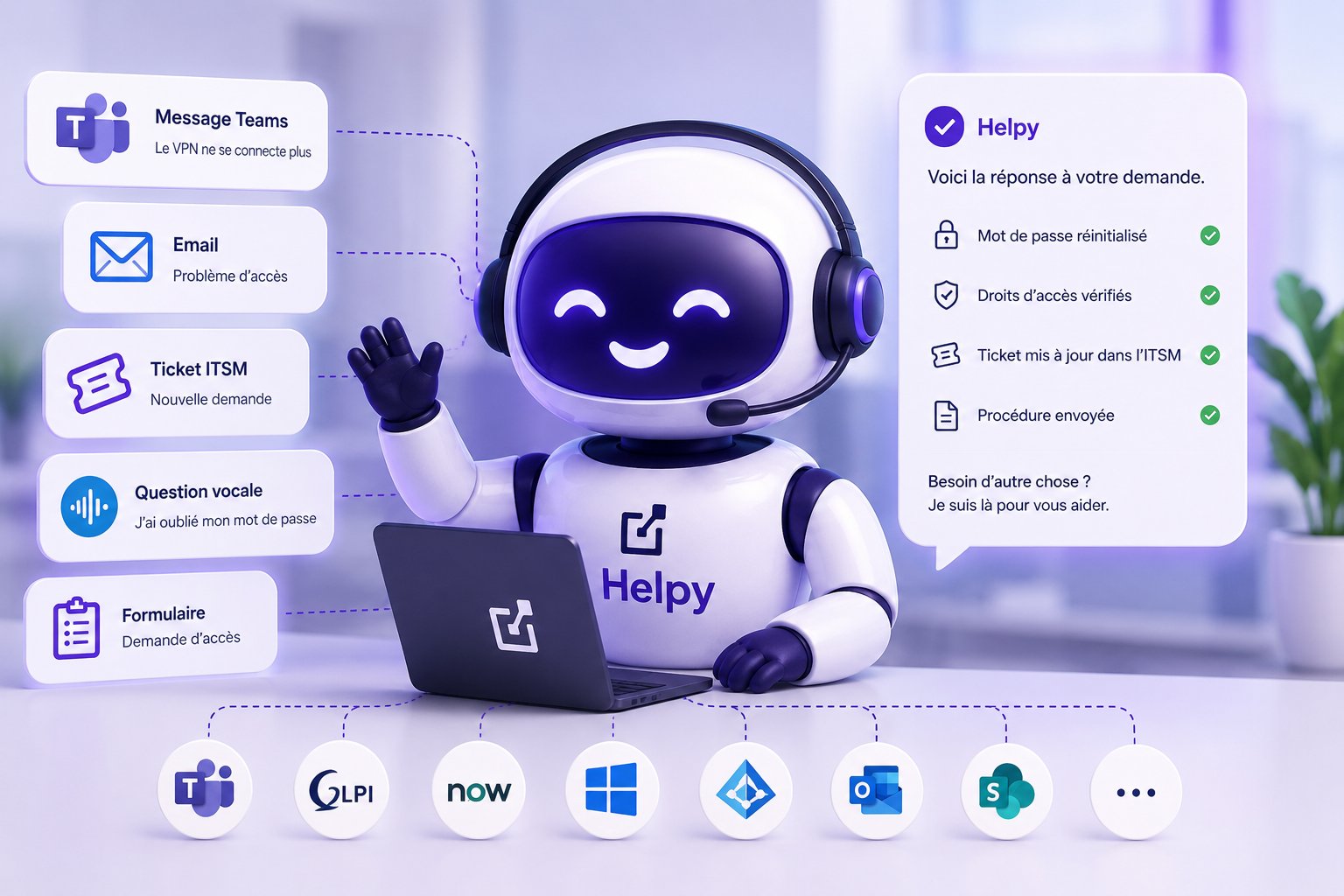
Document search in your internal databases, answers to frequently asked questions, assisted writing, and diagnostic support. Our AI agents for businesses integrate directly into your business software.
Example: A law firm equips its case management software with an AI agent capable of using natural language to find all contracts containing a specific clause in its document database—a task that used to take hours to complete manually.
Automate end-to-end processes
When combined with workflow orchestration and tools such as Power Automate, AI triggers and chains together actions across your applications without any manual intervention.
Example: For a service company, every signed quote automatically triggers the creation of a customer file, the sending of the contract, and the scheduling of the first appointment—without a sales representative having to re-enter the information into three different tools.
What’s the key difference between this and “AI-powered” SaaS? With custom software, AI works with your specific data and processes—not with a generic model designed for 80% of companies in your industry. For a comprehensive comparison of SaaS and custom software (costs, timelines, code ownership), see our guide on how to choose business software.
Summary by Sector
| Sector | Typical AI Use Case | What it replaces |
|---|---|---|
| Accounting | Invoice OCR + Pre-Posting | Manual entry, line by line |
| Legal | AI-Powered Document Search Agent | Manual Search in the Archives |
| Industry | Anomaly Detection, Predictive Maintenance | Corrective Maintenance Following a Breakdown |
| Services / Consulting | Automation of quotes → files → scheduling | Re-entered across multiple tools |
| Retail / Distribution | Scoring and Demand Forecasting | Rough estimates |
Custom Use Cases
Which AI use case would have the greatest impact at your company?
Our experts work with you to identify processes with a high ROI before writing a single line of code.
Discuss my project →AI, Data, and Sovereignty: The Key Point Not to Overlook
Integrating AI also means entrusting your data to it. Three requirements must be established from the outset: hosting in France or in a sovereign environment, native GDPR compliance, and a guarantee that your data will not be used to train a third-party model. Custom software puts you in control of these choices, unlike most consumer-facing AI services. This is a decisive factor for sensitive sectors such as legal, healthcare, the public sector, and manufacturing.
Your software, powered by AI
Custom business software, with AI where it counts.
IT Systèmes develops custom software that integrates AI where it adds value: proprietary code, hosted in France.
Explore our offerings and rates →Frequently asked questions
What is custom software that uses artificial intelligence?
This software is developed specifically for a company and incorporates AI capabilities (document recognition, prediction, chatbots, automation) tailored to its processes and data. Unlike a “AI-powered” SaaS solution, the AI here operates based on your business rules rather than a generic model.
What are the use cases for AI in business software?
The most common use cases include: automated document capture (OCR + NLP), forecasting and predictive maintenance, scoring, AI-powered search and assistance agents, anomaly detection, and cross-application process automation. The right use case depends on your industry—see the table above.
Does AI make custom development less expensive?
Yes, thanks to hyperdevelopment. Details on budgets and timelines can be found in our guide to custom software development: budget, timelines, and methodology.
Is my data secure with custom AI software?
They can be much more secure than with a consumer-grade service, provided you specify these requirements from the outset: hosting in France or on a sovereign platform, GDPR compliance, and no use of your data to train a third-party model. With a custom solution, you retain complete control.
Do you have to be a large company to integrate AI into your software?
No, not anymore. That's exactly what hyperdevelopment changes: a targeted project that incorporates AI can start small, with a specific use case, and then scale as your needs grow.
Is it possible to add AI to existing business software without having to rebuild everything from scratch?
Yes. An AI module (OCR, search agent, scoring) can be integrated into existing software via an API, without having to rebuild the existing system. This is often the quickest way to test a use case before scaling it up.
Wondering where AI would create the most value in your tools? Let's talk about your project: together, we'll identify the use cases with the highest ROI before writing a single line of code.




.svg)