.svg)
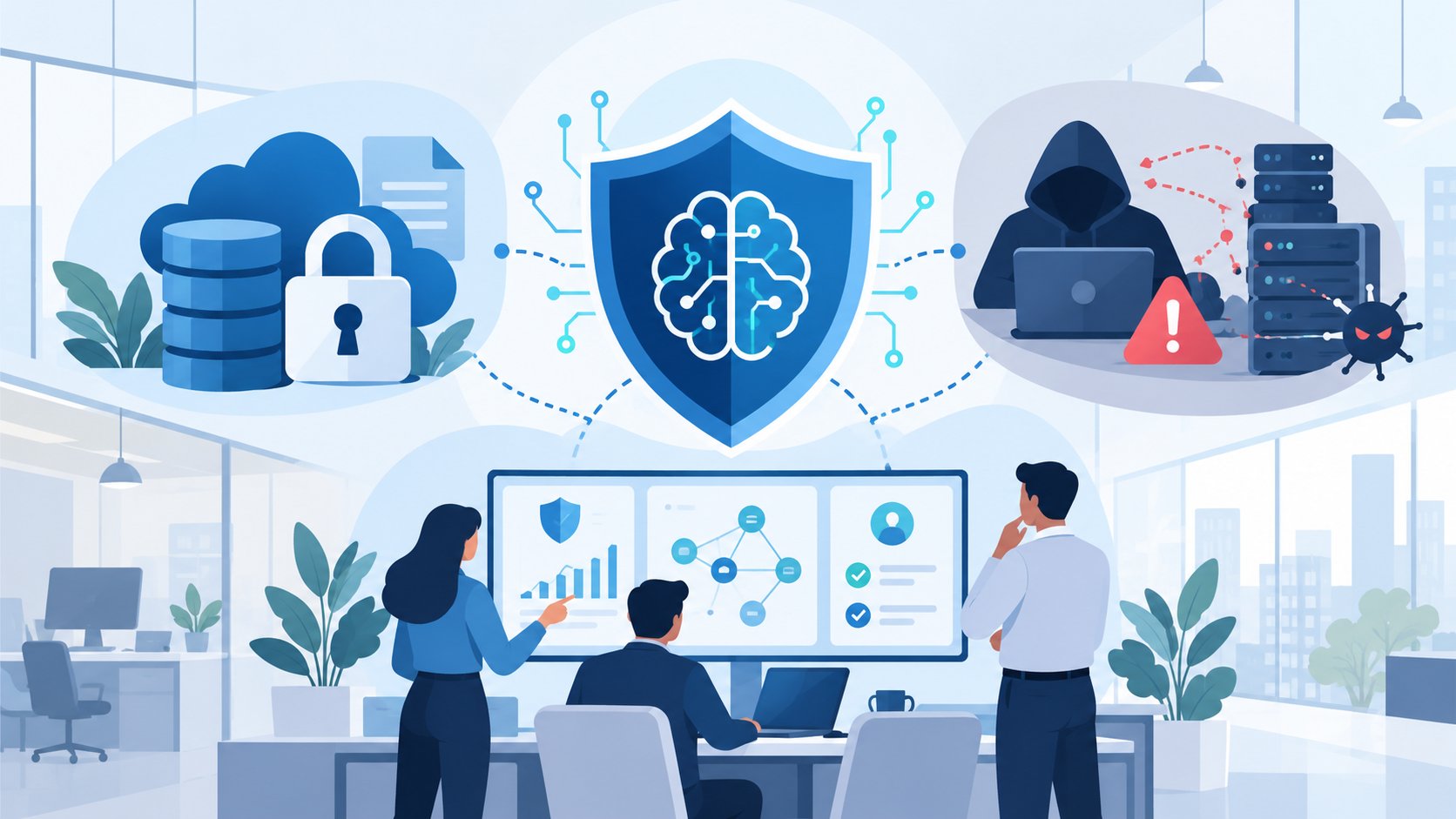
In AI and cybersecurity, three topics often overlap: securing the AI tools a company uses, using AI to better defend itself, and dealing with attacks that AI makes more effective. ANSSI explicitly distinguishes between them: cybersecurity of AI, cybersecurity through AI, and cybersecurity against AI. For an SME or mid-sized company, the first area is almost always the most urgent, because AI is already in use within the company, often without a defined framework.
The Three Dimensions of AI in Cybersecurity
| Dimension | The question | Examples |
|---|---|---|
| Securing AI | Are our AI tools and agents a point of entry or a source of leaks? | Confidential data posted in a public chatbot, prompt injection, AI agent with excessive permissions |
| Defending Yourself with AI | How does AI improve detection and response? | Behavioral detection (EDR, XDR), alert triage in a SOC, email analysis, analyst assistants |
| Dealing with AI-Powered Attacks | What's changing on the offensive side? | Flawless, personalized phishing; CEO fraud using deepfake voice technology; automated recognition |
Securing AI: The First Priority for an SME
Employees are already using AI assistants, often with their personal accounts. This is known as “shadow AI ”: contracts, customer data, or source code are being sent to services over which the company has no control. Simply banning their use isn’t enough; companies need to provide an enterprise-grade tool and a framework for its use.
AI agents pose a more technical risk. Unlike an assistant that simply responds, an agent takes action: it reads emails, reviews documents, and triggers actions within applications (see our guide on agent-based AI: definition, how it works, and uses). It can be misdirected through a prompt injection: a hidden instruction within the content it processes causes it to perform an unintended action. The OWASP Top 10 framework for LLM applications ranks this risk first, ahead of the disclosure of sensitive information, and also lists “excessive agency”: an agent granted more privileges than necessary.
The basic measures are well known:
- Minimum permissions for each agent, with its own identity, but never administrator privileges.
- Human approval required for sensitive actions: payment, deletion, external transmission, and modification of permissions.
- Logging what each agent does, so that their decisions can be reconstructed and investigated in the event of an incident.
- Controlling the data accessible to AI: classifying sensitive documents and establishing consistent access rules—otherwise, an assistant might uncover information that no one should have seen.
In April 2024, ANSSI published security recommendations for generative AI systems that cover the entire lifecycle, from training to production. For the method applied to agents, see our guide on how to secure an AI agent project in a business setting.
AI in Defense: What It Really Offers
AI is nothing new in cybersecurity: EDR and XDR solutions have been using machine learning for years to detect abnormal behavior rather than known signatures. What’s changing with generative AI is the support it provides to analysts.
The most useful AI applications in cybersecurity for small and medium-sized businesses:
- Alert triage. A SOC receives far more alerts than it can handle manually. AI groups related signals together, filters out obvious false positives, and sets priorities.
- The investigation. Summarize an incident, reconstruct the timeline, and translate a query written in natural language into the language of an SIEM such as Microsoft Sentinel.
- Email security. Modern filters analyze the context of a message—such as its tone, urgency, unusual requests, or an unfamiliar sender—rather than just its links and attachments. This is the solution to AI-generated phishing emails, which no longer contain spelling mistakes.
- Vulnerability management. Prioritize patches based on the actual exposure of assets rather than solely on the severity score.
Its limitations are also clear. AI depends on the quality of the data it receives: without centralized logs, it has nothing to analyze. It makes mistakes, and its errors are presented with confidence. The decision to isolate a workstation, suspend an account, or report an incident remains a human one. For an SME without a dedicated team, security AI is most often implemented through a managed SOC, not by purchasing yet another platform.
Are your uses of AI regulated?
Consult with an IT Systems expert to assess the AI tools used at your organization, the data at risk, and your employees’ rights.
AI-Powered Attacks
On the offensive side, the AI does not create a new category of attack. It makes existing attacks less costly and more credible:
- Phishing is becoming personalized, error-free, and written in the language and tone of the targeted company. The warning signs that teams used to be taught to look for (spelling mistakes, awkward phrasing) are disappearing. Spear phishing is now carried out on a large scale.
- Voices and videos can be replicated using just a few publicly available clips: this is "president fraud" using voice deepfakes.
- Reconnaissance (gathering information about the company, its employees, and its exposed systems) is becoming automated.
The solution isn't primarily a technological one. It involves procedures that don't rely on the credibility of a message: double verification of transfers, calling back a known number, and phishing-resistant multi-factor authentication for sensitive accounts.
The Regulatory Framework: AI Act, CNIL, and CIANum
An AI system is still an information system: the GDPR applies to the personal data it processes, and NIS2 applies to its security if the company is subject to it. The European AI Regulation (AI Act) adds its own obligations, which are being phased in gradually:
- As of February 2, 2025, users of AI are required to have a thorough understanding of the technology, making staff training a requirement rather than merely a best practice;
- Effective August 2, 2026, the transparency requirements of Section 50—such as informing a person that they are interacting with an AI;
- as of December 2, 2027, the obligations of the high-risk systems listed in Annex III, as deferred by Regulation (EU) 2026/1744.
In France, the Council for AI and Digital Technology (CIANum), an advisory body established in 2025, has published a series of reports on agent-based AI, including one on cybersecurity risks. Its report, published jointly with the CNIL on July 20, 2026, focuses on personal data: it reiterates that the GDPR applies to agent-based systems and recommends traceability mechanisms that make it possible to reconstruct an agent’s entire decision-making process. This is exactly what the logging described above enables.
To incorporate these requirements into a governance framework, see our Cybersecurity GRC Guide.
Where to Start: Six Steps
- Identify the actual uses of AI: relevant tools, services, and data processed.
- Provide an enterprise AI tool and guidelines for its use, rather than imposing a ban without offering an alternative.
- Classify sensitive data and verify access rights before granting an assistant access to your documents.
- Assign each AI agent an identity and minimum permissions, with human approval required for sensitive actions.
- Log and monitor the activity of AI tools just as you would for any other mission-critical application.
- Train teams on new phishing and fraud scenarios, as well as best practices for using AI.
IT Systèmes' Approach
IT Systèmes is not a provider of AI-based cybersecurity solutions. Our role is to integrate and operate: securing our clients’ use of AI, designing AI agents for businesses with controlled permissions, and monitoring their environments with detection tools that already incorporate AI. We also operate our own agent in production: the rules we recommend are the ones we follow ourselves.
Example: Helpy's guardrails
Helpy, the AI agent built into our Hypermanagement offering, handles Level 1 IT support for our customers. Several of the measures described above are implemented there:
- Specialized agents rather than a single agent. An orchestration agent distributes each ticket among agents dedicated to classification, diagnosis, resolution, documentation, and escalation preparation. One of these agents is responsible for verifying the security of the actions.
- Human approval is required before any changes are made. Any action that changes a user's position must be confirmed by the user, with the option to undo the change.
- A well-defined handoff process. Every ticket is documented. When an agent cannot resolve a request, they forward their assessment to a technician, who takes over the case without having to start from scratch.
- A metric published along with its calculation formula. From June to August 2026, Helpy received 1,889 tickets from its 55 clients under full-service management contracts: 60% were resolved without human intervention, in an average of 3 minutes. Any ticket handled by a technician—even if only partially processed by an agent—is excluded from this rate (source: Helpy monitoring tool).
The complete process for handling a ticket through Helpy is outlined in our Agent-Based AI guide.
Running agents in production requires a dedicated layer (access, identities, monitoring, traceability, costs): this is what our article “Agent-Based Infrastructure Operator: Definition and Role” describes.
Our cybersecurity team includes Hakim Taoussi, a Microsoft MVP for Security.
FAQ
Will AI replace cybersecurity analysts?
No. It handles the volume of data (sorting alerts, generating summaries, identifying correlations) and leaves the investigation and decision-making to analysts. Its errors—presented with confidence—make human oversight essential.
What is a prompt injection?
A malicious instruction hidden within content processed by an AI (email, document, web page) that causes it to perform an unintended action. This is the top risk identified in the OWASP framework for LLM applications, and it is all the more serious when the agent has extensive privileges.
Is it dangerous to use ChatGPT in a business setting?
The main risk comes from personal accounts and the data stored in them. A business plan—with contractual commitments regarding data usage, a policy, and a classification system for sensitive information—significantly reduces this risk.
What are the use cases for AI in cybersecurity?
Behavioral threat detection, alert filtering and prioritization, investigation support, analysis of suspicious emails, and prioritization of vulnerabilities to be patched.
What do CIANum and the CNIL recommend regarding agent-based AI?
The Council for AI and Digital Technology has published several reports on agent-based AI, including one on its cybersecurity risks. The report dated July 20, 2026, co-authored with the CNIL, notes that the GDPR applies to agents and recommends full traceability of their decisions.
Does an SME need an AI platform for its cybersecurity?
Rarely in real time. The tools available on the market (EDR, email filtering, SIEM) already incorporate AI. For an SME, the key is to ensure these tools are properly configured and monitored—which a managed SOC can provide—rather than adding another platform.
Deploy AI Without Creating New Security Vulnerabilities
Defining usage policies, employee rights, and oversight: support that complements your IT outsourcing and security services.
Article written under the direction of Samir AMARA, President of IT Systèmes.
Sources: ANSSI, Security Recommendations for a Generative AI System (April 2024); OWASP, Top 10 for LLM Applications; CNIL and the Council for AI and Digital Technology, note on agent-based AI and personal data, July 20, 2026; Regulation (EU) 2024/1689 and Regulation (EU) 2026/1744, EUR-Lex; Helpy Barometer, June–August 2026, Helpy monitoring tool.
.png)




.svg)