.svg)

As of September 1, 2026, all businesses subject to VAT in France must be able to receive electronic invoices. Large companies and mid-sized companies must also issue them. Small and medium-sized enterprises (SMEs), very small enterprises (VSEs), and micro-enterprises will follow on September 1, 2027 (official timeline available at economie.gouv.fr).
For those who process supplier invoices, this marks the end of a significant portion of the data-extraction work. An invoice in Factur-X, UBL, or CII format that arrives via an approved platform is already structured: the supplier, the pre-tax amount, the VAT, and the SIREN number are fields, not pixels to be deciphered. Yet it was this data extraction that justified most OCR projects.
As for the rest of the work, that remains unchanged. You still need to verify that the invoice matches what was ordered and delivered, address any discrepancies, follow up with the supplier when necessary, and manage any items that don’t meet the criteria for disposal. This is where an AI accounting agent proves its worth—provided you first take a look at what your software is already capable of.
How the Reform Changes the Processing of Invoices
| Step | Before September 2026 | With electronic invoicing |
|---|---|---|
| Reception | PDF via email, paper, supplier portals | Data feed received by an approved platform in Factur-X, UBL, or CII format |
| Data Extraction | OCR, with reading errors to correct | Data that is already structured. OCR is now used only for documents not covered by the reform. |
| Items to Check | Standard Legal Disclaimers | Four additional fields: customer's SIREN number, transaction category, VAT option for debits, and shipping address (if different) |
| Work Remaining | Data Entry, Verification, Reconciliation | Verification, Reconciliation, and Variance Resolution |
Not all documents will go through this system. Until September 2027, many small and medium-sized business suppliers will continue to send PDFs, since they are not yet required to issue electronic invoices. Invoices from foreign suppliers remain outside the scope of domestic electronic invoicing (they fall under e-reporting). And expense report receipts will remain unchanged. For all of these, it will still be necessary to extract data from documents.
The selection and integration of the certified platform are covered in a separate article: Electronic Invoicing and PDP: Preparing Your Accounting Firm’s IT Infrastructure.
What Your Accounting Software Already Does
Before you start looking for an agent, take a look at what you’re already paying. Pennylane includes its own document recognition feature and offers to reconcile bank transactions with supplier invoices (Pennylane documentation). The Cegid and Sage suites also offer automation features, the scope of which depends on the version and the modules you’ve subscribed to.
If your needs are limited to retrieving invoices, linking them to payments, and pre-filling journal entries, an AI agent won’t be of much help to you. We’d rather state this here than discover it together with you at the end of an audit.
What an AI agent brings to your software
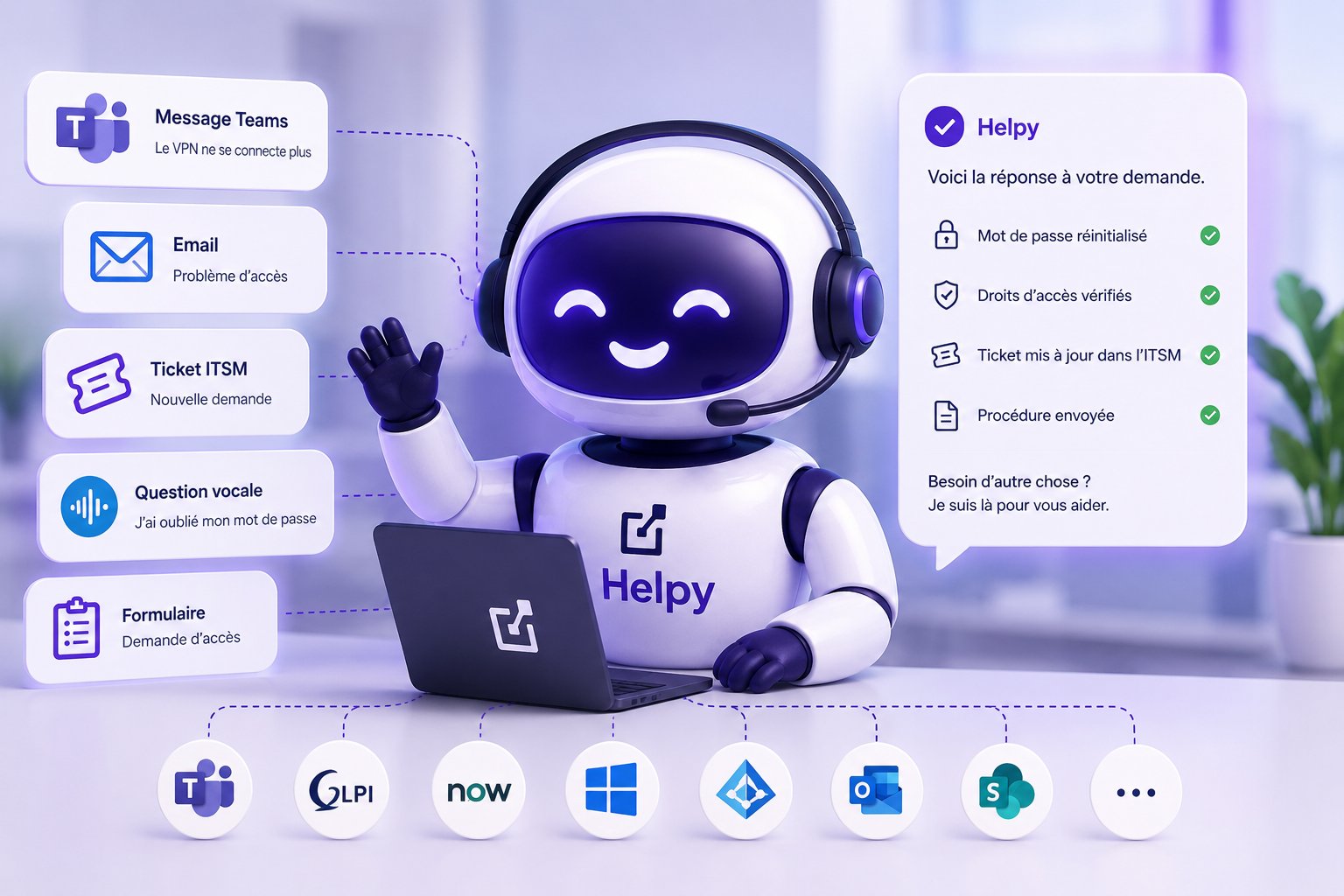
The agent integrates with your accounting software and other tools. Its value lies in two things that the software struggles to do on its own: cross-referencing multiple sources at once and applying rules specific to your business.
Verify that the invoice matches the purchase order and the delivery
An invoice that is correct in form may be incorrect in substance. If the quantity billed exceeds what was delivered, or if the price differs from the contract price, this is not immediately apparent from the invoice itself. The agent compares the invoice to the purchase order and the receiving document—whether they are stored in an ERP system, a procurement tool, or a shared spreadsheet—and flags discrepancies that exceed the threshold you have set.
Handling Exceptions as They Occur
Invoice rejected by the platform, credit memo not linked to any invoice, unknown supplier, ambiguous expense account. Currently, these cases pile up in a queue that someone clears out at the end of the month. The agent prepares each file with the related documents, the supplier’s history, and a proposed account assignment. Depending on your policies, the agent may also draft a credit memo or correction request. The final decision rests with an accountant.
Incorporate non-rejected parts into the same process
Expense reports, foreign invoices, and PDFs from suppliers who do not yet issue electronic invoices: the agent extracts the data, verifies compliance with your expense policy, and routes these documents through the same approval process as electronic invoices. You maintain a single process instead of running two in parallel until 2027.
Check invoices issued before sending them
For businesses already subject to the reporting requirement, an invoice that does not include the customer's SIREN number or transaction category poses a problem. The agent can verify this information before sending the invoice, using data from your CRM or invoicing tool.
The Case of Accounting Firms
In a law firm, each client has its own software, habits, and billing rules. An agent who has access to multiple clients’ files applies each client’s rules and only escalates matters to the attorney that require judgment. We save a little time on each case, but the real benefit lies elsewhere: the same team can handle more cases, and that changes the firm’s cost structure. The integration with Cegid is detailed in our article on automating accounting processes in law firms.
Winnings: Why We Don't Give a Percentage
You see claims of “70 to 80 percent savings on data entry” everywhere. Without specifying the time period, volume, type of documents, and calculation method, this figure says nothing about your specific situation. It says even less in 2026, since data entry is precisely the part that electronic invoicing reduces on its own.
During the pilot, we take measurements on your parts using metrics that you can recalculate yourself:
| Indicator | How it is calculated |
|---|---|
| Average time per piece | Timed using a sample prior to the pilot, then using the same type of parts during the pilot |
| Parts processed without human intervention | Invoices received by the accounting department without human correction, divided by the total number of invoices received during the period |
| Errors Detected During Proofreading | Transactions corrected during the review, as a percentage of the total number of transactions prepared by the agent |
| Exception Processing Time | Time elapsed between the detection of an issue and its resolution |
These weekly reports are used to determine whether to extend the agent to other workflows. They're better than a round number because you can review them line by line.
At what volume does an AI accounting agent become cost-effective?
There is no one-size-fits-all threshold. It all depends on how much time the agent saves on each item, and that time varies greatly from one workflow to another.
In your case, the calculation takes five minutes. Let’s use a hypothetical example—which you can replace with your own figures: 1,000 items per month and a time savings of 2 minutes per item. That comes to 1,000 × 12 × 2 = 24,000 minutes, or 400 hours per year. Multiply that by the full hourly rate of the person doing this work, then compare it to the project cost and the annual operating cost.
If the actual time saved is one minute per part instead of two, the result is halved. That’s why we time each part before calculating anything. The complete method is described in “What ROI Can You Expect from an AI Agent Project?”
Your Data: Questions to Ask Before Signing
For a firm bound by professional confidentiality, as well as for a company that outsources its supplier transactions to a third party, this is often the first objection raised. It is a legitimate concern. No matter which service provider you choose, ask them:
- where the components and data are hosted, and in which country;
- which AI model is used, and whether your data can be used to train it;
- How long does the agent keep the documents and logs?;
- who, in his office, can access which files;
- if every action taken by the agent is logged in a log that you can view;
- At what point does a human validate it before a write operation is performed?
A vague answer to any one of these questions is enough to rule out a service provider for accounting processes.
How We Deploy an AI Accounting Agent
It all starts with an assessment: monthly transaction volume by type, existing validation rules, the quality of historical data, and the accounting software and approved platform in use. This is also when we time the process per transaction.
This involves a pilot project using a single data stream—typically supplier invoices. Its duration depends on the number of sources to be connected and the quality of the data, and it is determined at the end of the scoping phase. The scoping phase also serves to verify, on a per-software-application basis, how the agent will connect to your accounting software. The metrics in the table above are tracked weekly.
If the results warrant it, the tool is expanded to include expense reports, then bank reconciliations and the verification of issued invoices.
In terms of budget, expect to spend between €5,000 (excluding tax) for a single-task agent and €30,000 (excluding tax) for a multi-agent solution that handles multiple workflows. Details on the cost components can be found in “How Much Does an AI Agent Cost for a Business?”
Frequently asked questions
Does electronic invoicing make OCR obsolete?
This applies mainly to invoices received through an approved platform, since their data is already structured. OCR remains useful for expense reports, invoices from foreign suppliers, and PDFs from suppliers who are not yet required to issue electronic invoices.
Does an AI agent replace the certified platform?
No. The approved platform forwards invoices and data to the government agency. The agent works after receiving the invoices—or before they are issued—to review them and prepare for the resolution of discrepancies.
Pennylane already handles bank reconciliation—so what's the point of having an additional agent?
If that's all you need, it's not much. The agent becomes useful when you need to cross-reference multiple sources (orders, deliveries, contracts), apply rules specific to your company, or track a large number of cases.
Can an AI accounting agent replace an accountant?
No. He prepares the journal entries and points out what's wrong. Questionable accounting classifications, audits, tax returns, and advice remain the accountant's responsibility.
At what volume does an AI accounting agent become profitable?
There is no set threshold. Multiply the number of items per month by the time saved on each item—based on your own workflow—and compare the result to the project cost.
Learn more
Want to know if your volume of cases justifies an agent? Our custom AI agents for businesses showcase the use cases we've implemented, and you can describe your workflows to us so we can discuss them.





.svg)