.svg)
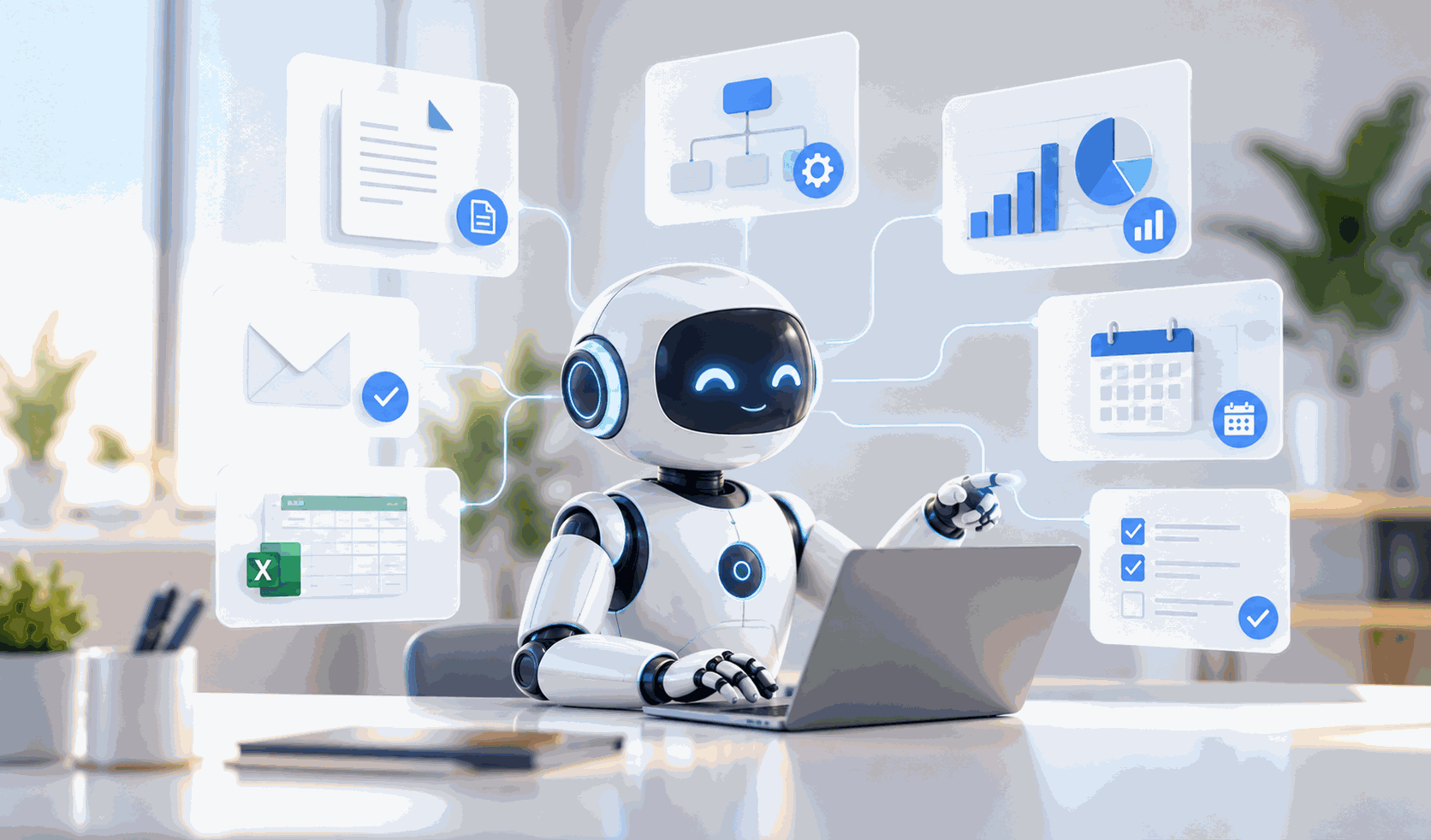
Short answer. Agent-based AI refers to artificial intelligence systems capable of pursuing a goal autonomously: they gather information, plan steps, take action within software, and adjust their plan based on the outcome. Whereas generative AI produces content, agent-based AI takes action. In English, it is called “agent-based AI”; it is also sometimes referred to as “agentive AI.”
Definition of Agent-Based AI
The CNIL defines agent-based AI as a set of systems that rely on the coordination of multiple AI agents. These agents are often built around a generative AI model. They can interact with a defined environment (applications, databases, workstations) and modify its state: reading, modifying, or deleting data, or performing actions. Their level of autonomy varies from one system to another.
The term “agent-based” refers to the ability to act. An AI agent is the basic unit: a program that receives an objective (“process this month’s leave requests”) rather than a single instruction, and decides for itself what steps to take. Agent-based AI refers to the whole system: the agents, their coordination, and the rules that govern them. We discuss the agent itself in detail in our article “AI Agents in Business: Definition and Use Cases.”
Agent-based AI, generative AI, chatbots, RPA: What are the differences?
| Type | What he does | Who decides on the steps? | Example |
|---|---|---|---|
| Generative AI | Generates content based on a request | The user | Writing a Follow-Up Email |
| Chatbot | Responds within a conversation, often drawing on a knowledge base | The scenario or the user | How to answer "What are your hours?" |
| RPA (Robotic Process Automation) | Performs a fixed sequence of clicks and keystrokes | The developer, in advance | Entering Invoices into an ERP System |
| Agent-based AI | Pursues a goal by selecting and carrying out actions | The agent, within the established limits | Handling a Support Ticket from Start to Finish |
Generative AI proposes; agent-based AI executes. RPA follows a predefined path, while the agent chooses its own. This is what makes it useful for handling varying scenarios, and it’s also why it needs to be supervised. For a detailed look at the difference between an AI agent and a chatbot, see our article “AI Agent vs. Chatbot: What Are the Differences for Businesses?”
How Does Agent-Based AI Work?
An agent-based system operates in a continuous loop until it achieves its goal or hands off to a human:
- Perception: The agent gathers relevant information, whether it pertains to a request, data, or the status of a system.
- Reasoning: The language model interprets the situation and identifies what matters.
- Planning: The agent breaks the goal down into steps.
- Action: It performs a step using a tool (read a database, edit a record, run a script).
- Reflection: It checks the result, adjusts its plan, or stops and hands it off to a human.
This cycle is built on four building blocks. The language model (GPT, Claude, Mistral) performs reasoning. Tools and connectors provide access to enterprise applications; protocols such as MCP (Model Context Protocol) or A2A (Agent2Agent) standardize these exchanges. Memory retains the context of a task and, in some cases, the history of exchanges. Safeguards limit what the agent can do and specify when human approval is required.
Example: A ticket titled “My PC is running slowly” handled by an agent
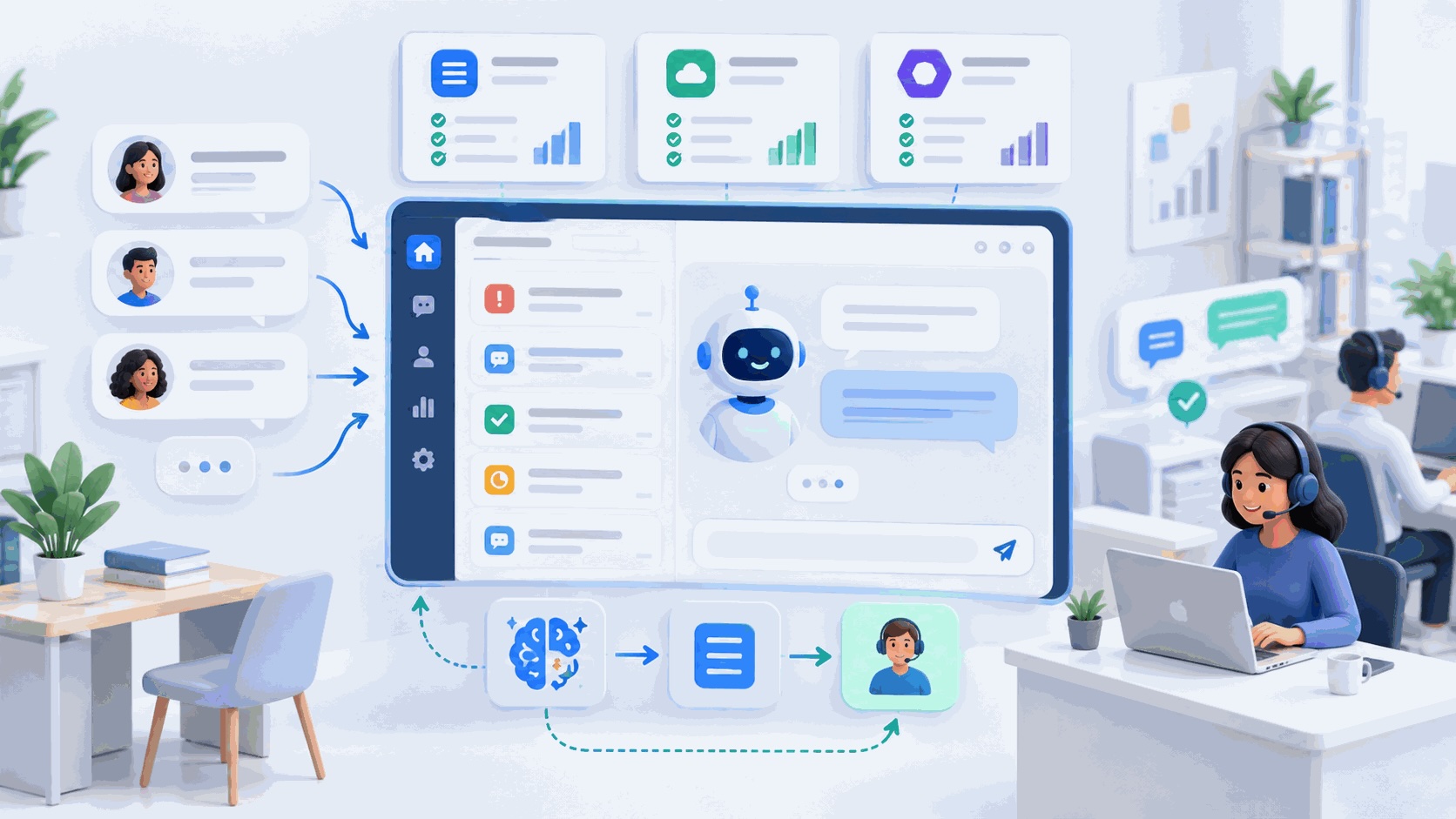
Helpy, the AI agent built into our Hypergérance offering, handles Level 1 IT support. Here's how it follows this process for a typical ticket:
- Incident Handling: The ticket comes in, the agent logs it (based on the workstation's performance; simple request) and logs into the user's workstation to assess the situation.
- Reasoning: It identifies the cause—for example, an application that is hogging the CPU on a computer that hasn't been restarted in several weeks.
- Planning and Action: It suggests a correction to the user, waits for confirmation, and then carries it out. Any action that changes the record requires this confirmation, with the option to undo the change.
- Follow-up: He verifies that the situation has been resolved, documents the ticket, and adds information to the customer's knowledge base.
If he is unable to do so, he compiles his findings and forwards them to a technician, who takes over the case without having to start from scratch.
The AI Orchestrator
When multiple agents are involved, an orchestrator divides up the work: which agent handles which step, in what order, and what to do in case of failure. In Helpy, an orchestration agent distributes each ticket among specialized agents: classification, diagnosis, correction, security checks on actions, documentation, and preparation for escalation.
Multi-agent systems
A multi-agent system assigns each part of a process to a specialized agent. Specialization makes each agent easier to test and monitor, but at the cost of more demanding coordination. Two organizational structures coexist. In the first, a hierarchical structure, a lead agent supervises simpler agents: this is effective for sequential workflows, but the lead agent can become a bottleneck. In the second, a more horizontal structure, agents cooperate without a leader: this is more flexible, but often slower.
Architecture and Agent-Based Platform
Agent-based architecture describes how these building blocks fit together: which models, which connectors, which orchestrator, and which controls. An agent-based platform provides some of these building blocks out of the box. Microsoft Copilot Studio, for example, lets you create agents connected to Microsoft 365 data. Our comparison of AI automation tools reviews the main options.
Types of AI Agents
Agents are classified based on how they make decisions, ranging from reactive agents that apply fixed rules to agents capable of learning from their results. We detail the seven categories of Russell and Norvig’s classification, along with their applications in small and medium-sized businesses, in our guide, “24/7 AI Agents for Small and Medium-Sized Businesses.”
How Agent-Based AI Is Changing Businesses
Agent-based AI handles repetitive yet variable processes where a fixed rule is not sufficient: first-level IT support, internal requests, triaging incoming requests, preparing files, and conducting document research. It operates continuously, freeing teams from low-value tasks so they can refocus on complex cases.
Looking at our own operations from June through August 2026, Helpy received 1,889 tickets from its 55 clients under full-service management contracts (680 in June, 720 in July, and 489 in August). 60% were resolved without human intervention, in an average of 3 minutes. Any ticket handled by a technician—even if only partially processed by the agent—is excluded from this rate. Source: Helpy monitoring tool.
For other business-specific uses (support, human resources, finance, legal), see our page on AI Agents for Businesses.
Limitations and Risks of Agent-Based AI
The autonomy that makes an agent valuable also poses risks.
- Chain reactions: In a multi-agent system, one agent's error becomes the input for the next. A deadlock or resource conflict can spread throughout the entire process.
- Actions that are difficult to undo: When an agent deletes, sends, or modifies something, it has a real-world impact. This is why human confirmation is important for sensitive actions.
- Personal Data: In their memorandum dated July 20, 2026, the CNIL and the Council for AI and Digital Technology note that agents transmit personal data between numerous departments, and that their persistent memory increases the amount of data stored. They also emphasize that this operation complicates the allocation of responsibilities among the various parties involved.
- Data quality: An agent who makes decisions based on incorrect or outdated data is more likely to make mistakes—and more quickly.
- Costs: Each step requires computational resources. Without monitoring, the cost of a task can spiral out of control.
Integrating Agent-Based AI into the Information System
An agent can only create value if it has access to the right tools: ERP, CRM, email, and ticketing systems. Integration raises architectural questions (available APIs, authentication, data hosting) rather than questions about model selection. Our CIO guide to integrating an AI agent into an existing IT system details the process.
Governance of Agent-Based AI
An agent that takes action is managed like an employee who has been granted access: we define what it can do, who approves it, how it is monitored, and who is accountable for it.
Set a level of autonomy for each task. Not all actions are equal. A handy chart distinguishes four levels:
| Level | The officer… | Example |
|---|---|---|
| 1 | suggests, a human carries out | Suggest a response to a customer |
| 2 | executes after human approval | Correcting an Entry After User Confirmation |
| 3 | executes and then reports on | Close a resolved ticket |
| 4 | performs the task on his own, under supervision | Reset a password according to an established procedure |
Maintain a registry of employees. For each employee: their objective, access rights, level of autonomy, supervisor, and the associated data processing activities in the GDPR registry.
Give each agent its own identity. A dedicated account, with only the minimum necessary permissions, allows you to revoke an agent's access without affecting human accounts and to track its actions in the logs.
Comply with the AI Act. The European AI Regulation (Regulation (EU) 2024/1689) has required, effective February 2, 2025, that staff who use AI receive training. As of August 2, 2026, the transparency requirements of Article 50 apply: a person interacting with an agent must be aware that it is an AI. The obligations specific to high-risk uses listed in Annex III, such as recruitment or creditworthiness assessment, have been postponed to December 2, 2027, by Regulation (EU) 2026/1744.
Securing Agent-Based AI
An agent expands the attack surface: it has access privileges, reads content that may contain malicious instructions, and acts quickly. The ANSSI guide “Security Recommendations for a Generative AI System” recommends, in particular, controlling the AI system’s interactions with business applications, limiting automated actions when the AI processes uncontrolled inputs, and logging processing activities. We detail these practices in our article “How to Secure an AI Agent Project in a Business Setting.”
Agent-based infrastructure: Running agents in production
Beyond the first agent, a company needs a layer that connects its agents to its data and applications and provides ongoing support: connectors, identities and permissions, orchestration, monitoring, traceability, cost control, and compliance. This is what’s known as an agent-based infrastructure. The service provider that designs, secures, and continuously operates this infrastructure is an agent-based infrastructure operator. We detail this role in our article “Agent-Based Infrastructure Operator: Definition, Role, and Selection Criteria.”
Frequently asked questions
What is agent-based AI?
It is an AI capable of pursuing a goal autonomously: it gathers information, plans steps, takes action within software, and adjusts its plan based on the results.
What is the difference between agent-based AI and generative AI?
Generative AI produces content based on a prompt: text, an image, or code. Agent-based AI uses these capabilities to take action: it performs actions within a company’s software to achieve a goal. Generative AI proposes; agent-based AI executes.
What is the difference between an AI agent and agentic AI?
An AI agent is the basic unit: a program that pursues a goal using tools. Agent-based AI refers to the entire system, which may include multiple agents, an orchestrator, and the safeguards that govern them.
Is agent-based AI replacing traditional automation?
No. Fixed-rule automation remains simpler, less expensive, and more predictable for a stable process. Agent-based AI complements it for cases that vary and require reasoning.
How do you measure the return on investment of an AI agent?
Before deployment, define a metric and its calculation formula—for example, the percentage of tickets closed without human intervention, excluding any tickets handled by a technician. We then compare this to the time and cost of manual processing over several months, including seasonal lulls. We detail this approach in our article “What ROI Can You Expect from an AI Agent Project?”
How much does an agent-based AI project cost?
At IT Systèmes, an AI agent starts at €5,000 for a single-task agent and goes up to €30,000 for a multi-agent solution. Details can be found in our article “How Much Does an AI Agent Cost for a Business?”
Where do you start with agent-based AI?
Through a repetitive, high-volume, and easily measurable process, in which any error made by the agent can be corrected. We set the agent's level of autonomy, measure its results over a few weeks, and then expand its scope.
Sources: CNIL, definition of “agent-based AI”; CNIL and the Council for AI and Digital Technology, note on agent-based AI and personal data, July 20, 2026; Regulation (EU) 2024/1689 and Regulation (EU) 2026/1744, EUR-Lex; ANSSI, Security Recommendations for a Generative AI System; Helpy Barometer, June–August 2026, Helpy monitoring tool.
.png)





.svg)